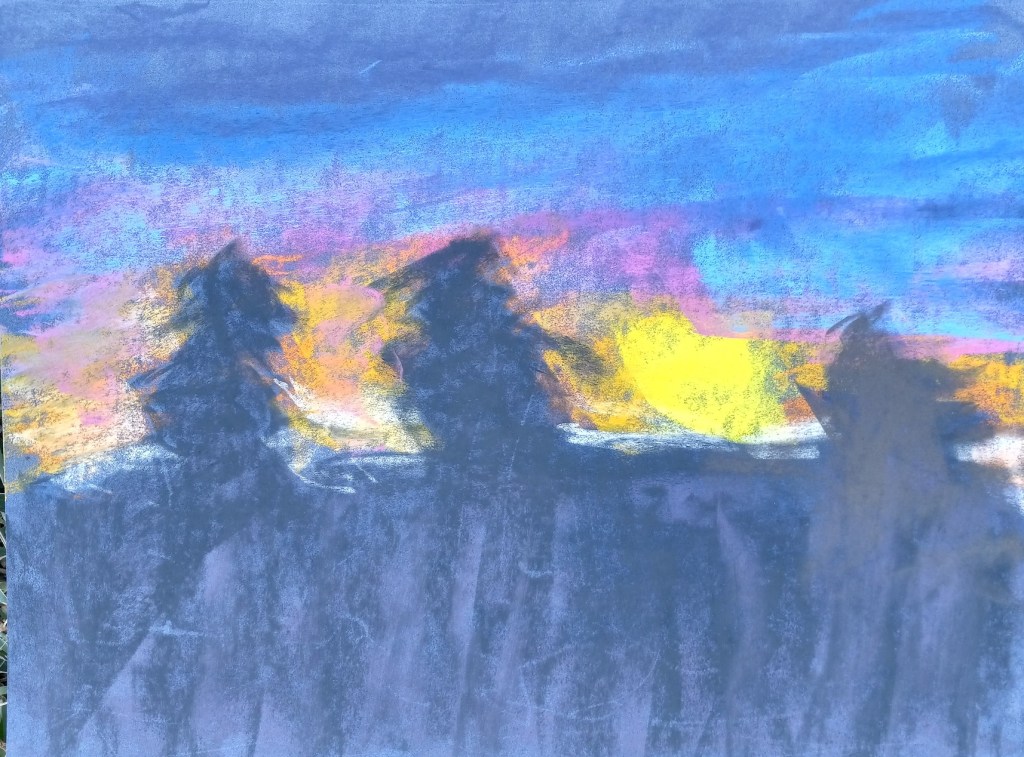
I had no idea what to paint today, so I just started randomly putting NuPastel on paper, and then I rubbed it in with a paper towel. Now I had an underpainting (of sorts) but didn’t know what to do with it — at first. Then I realized it reminded me of autumn trees.
My trees are cartoonish, but the whole picture is straight from my imagination, based on the colors and shapes of the random “underpainting”.
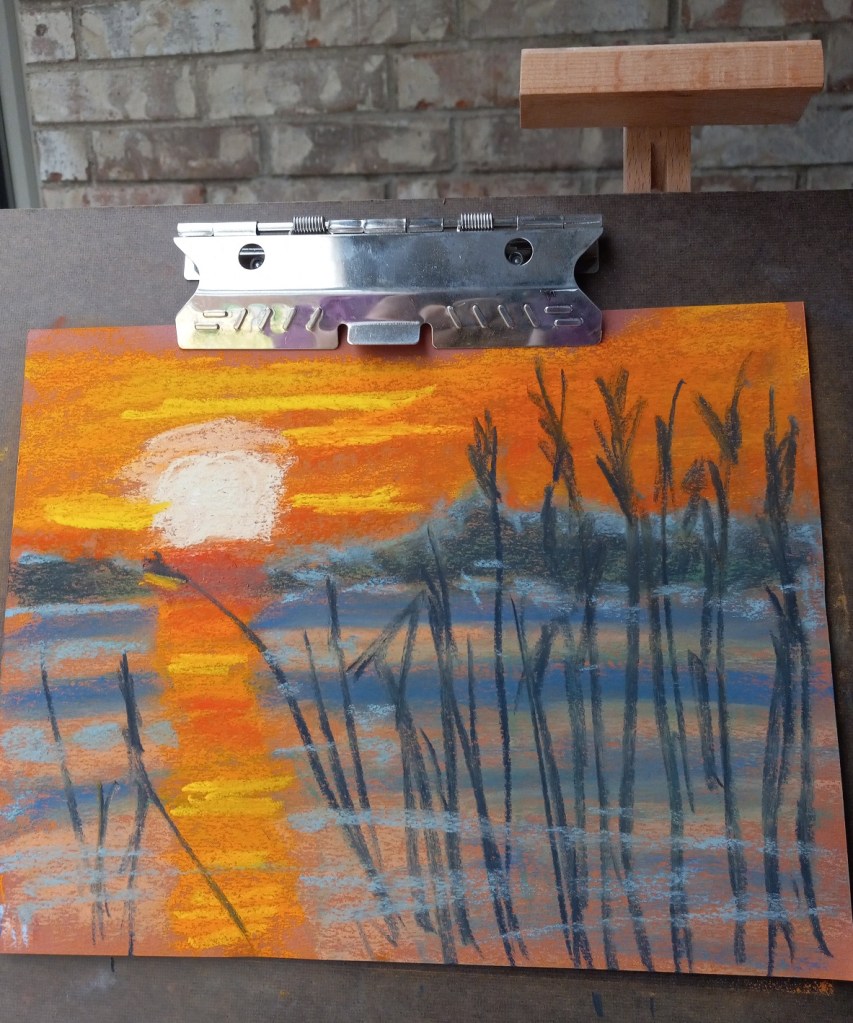
Yesterday’s sunset looked a bit like a fried egg, didn’t it? So I tried it one more time. This time I used Art Spectrum Colourfix paper, in the Terracotta shade.
While this painting is hardly a masterpiece, I feel most satisfied with it, and I finally got the reflection looking a bit more realistic than on my previous tries.
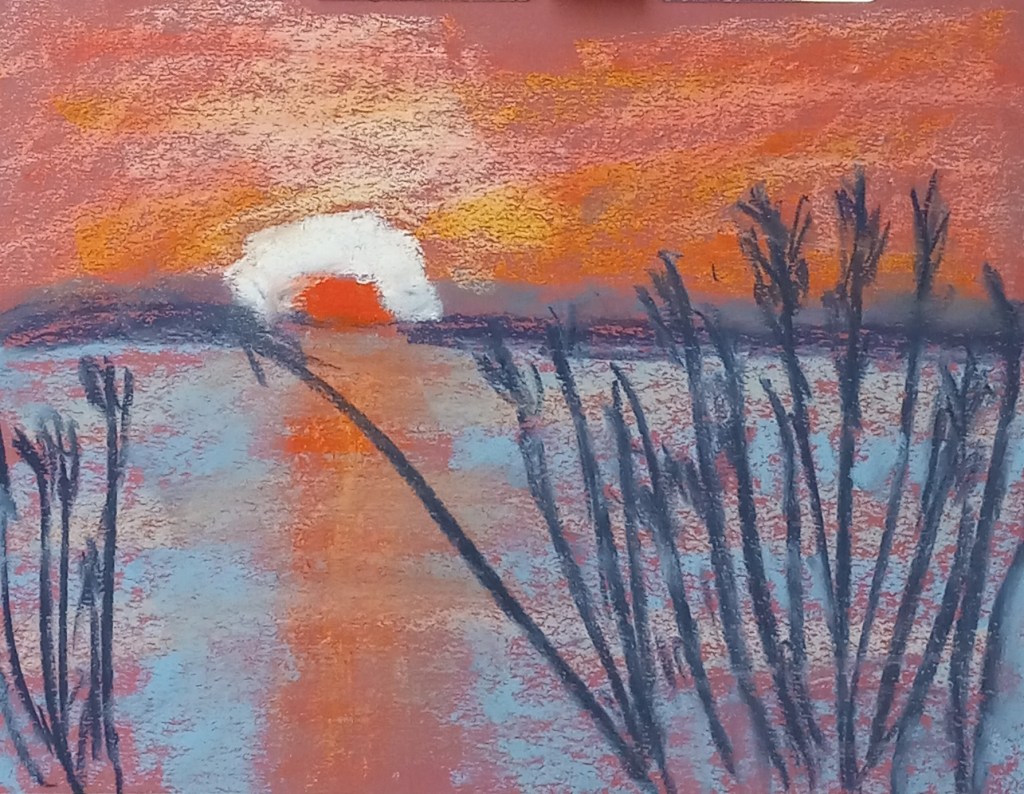
Today I did another study of the reedy lake (again on Canson Mi-Teintes Red Earth colored paper). I used a different pastel palette than I did before, and I did not do any underpainting.
This time, I think I did a better job of painting the sun’s reflection on the water.
Most of the pastels used were Richeson hand-rolled pastels, which seems to work for me on the Mi-Teintes paper, although it’s clear you can see a lot of the paper’s color coming through.
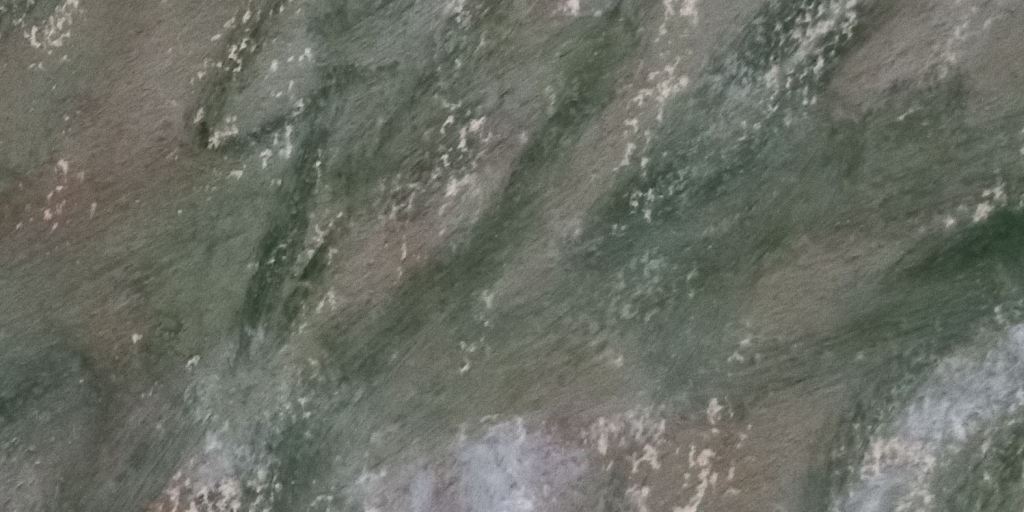
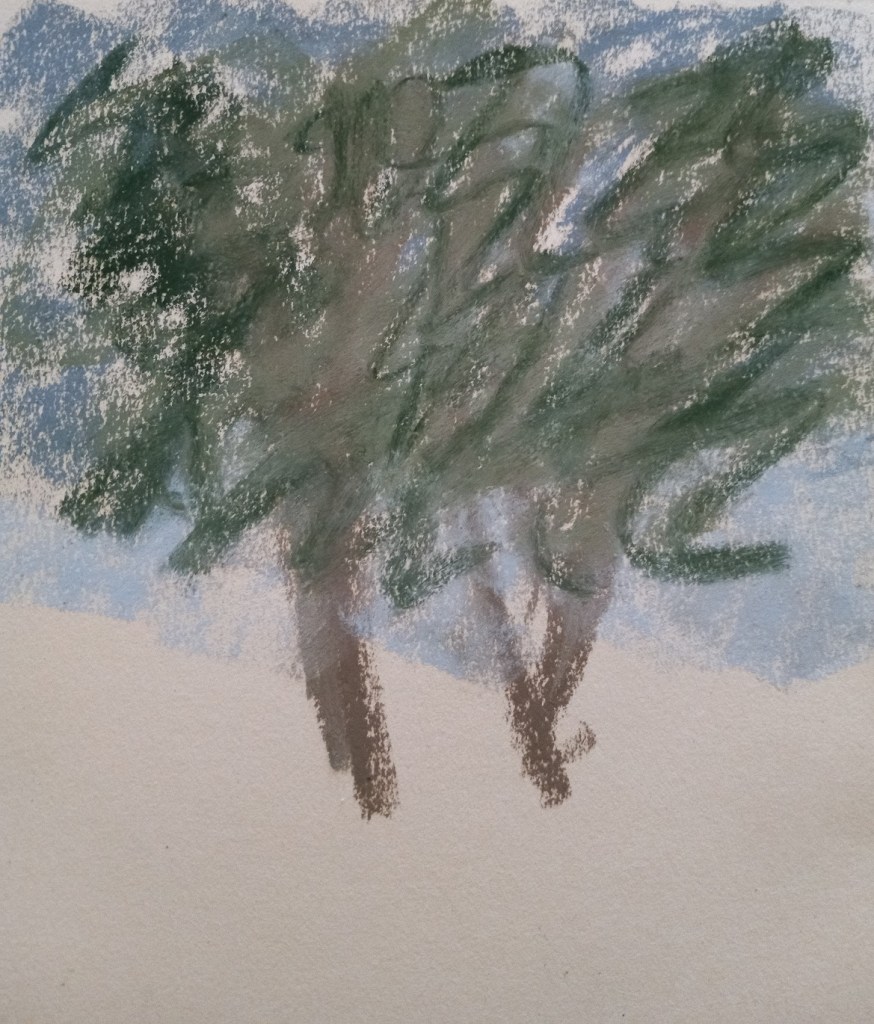
Early on while I was working on the “500 scenes”, it was a warm blustery day and it seemed to me the tree was energetic so I was using the pastel sticks energetically myself. And completely forgetting I was using Canson Mi-Teintes paper, which cannot take a lot of layers of pastels! When I added the dark green — or tried to – the stick just skittered off. Nothing was really taking, and the appearance was reminiscent of mud. I did NOT want the dark green to look like scribbles! Oh well.
Yes, I had heard of that occurring once the tooth of the pastel paper (any pastel paper!) is filled, but really, experience is the best teacher. Now that I’ve filled the tooth of the paper myself, and experienced the skipping and the muddy look, I totally get it.
There are so many things wrong with this picture — where do I begin?
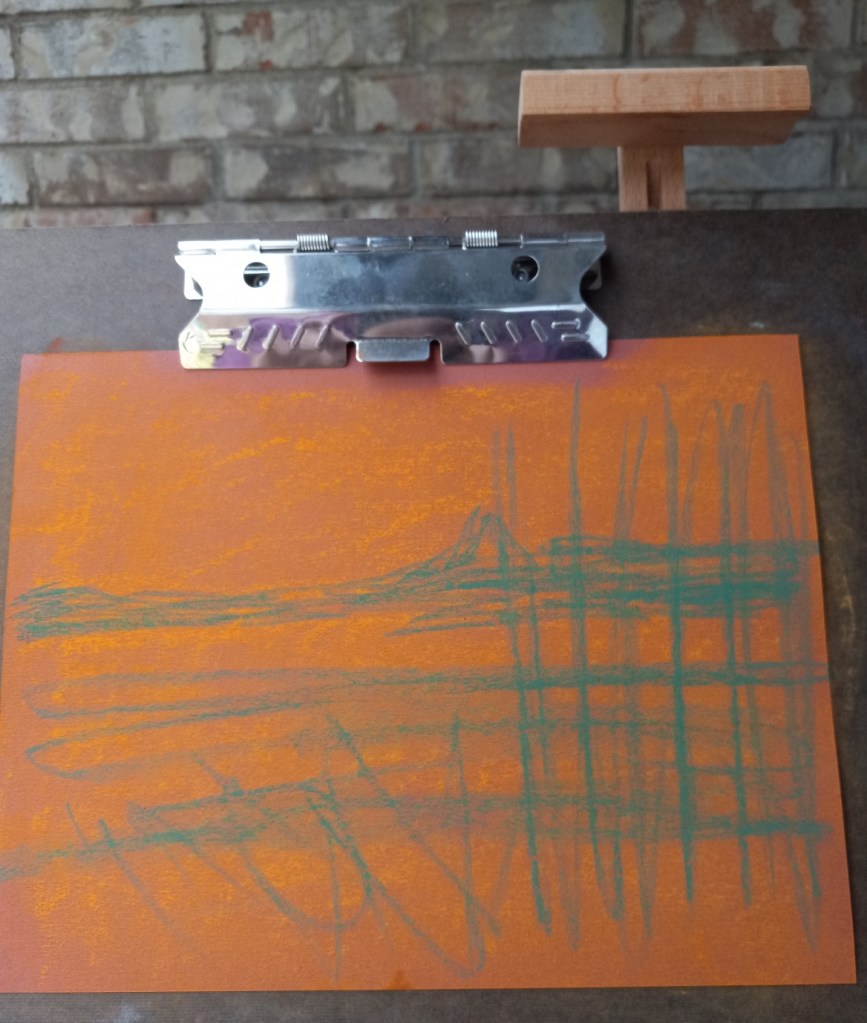
underpainting on Canson
finished painting on Canson
First of all, were I to do this again — IF I did the NuPastel underpainting — I would blend it in to the paper more effectively. I think I’d stick with the orange, but am undecided about the blue. I might try a medium green since green complements the red of the paper, and would blend in with the orange NuPastel and with the dark blue reeds.
The second, more obvious, item is the sun’s reflection on the water. That should have been a vertical line straight down the paper using the side of my pastel stick. And the water should have been painted in smoother, broader strokes. In fact, it might be better, compositionally, to assume still quiet water rather than the rippling water seen in the reference image.
I will have to redo this work and see what develops — hopefully, a better picture!
Okay, I think I’ve figured it out! The composition in the color study from the last post is utterly BORING!! Not to mention the dark mountain shapes looming over the scene… they just distract. The dark shapes take the viewer’s eye completely away from what I wanted to be the focus — the poppies against the lake. Worse, they look so forbidding and foreboding that it is completely off-putting — I just want to look away at something else entirely!
I’m cropping the photo further so that only the poppies, the foreground grasses (for the yellow-green counter-balance to the red flowers), and the teal blue lake show.
As with the color study, the tree at the right of the photo will be excluded in the painting I do.
UPDATE (next day): Now that I look at the photo again, I might just leave the tree. It occurs to me that what I know to be the lake might instead be seen as a smaller pond with distant mountains (the darker blue water current) and a blue sky (the lighter blue at the top of the photo). Hmmm. Something to think about.
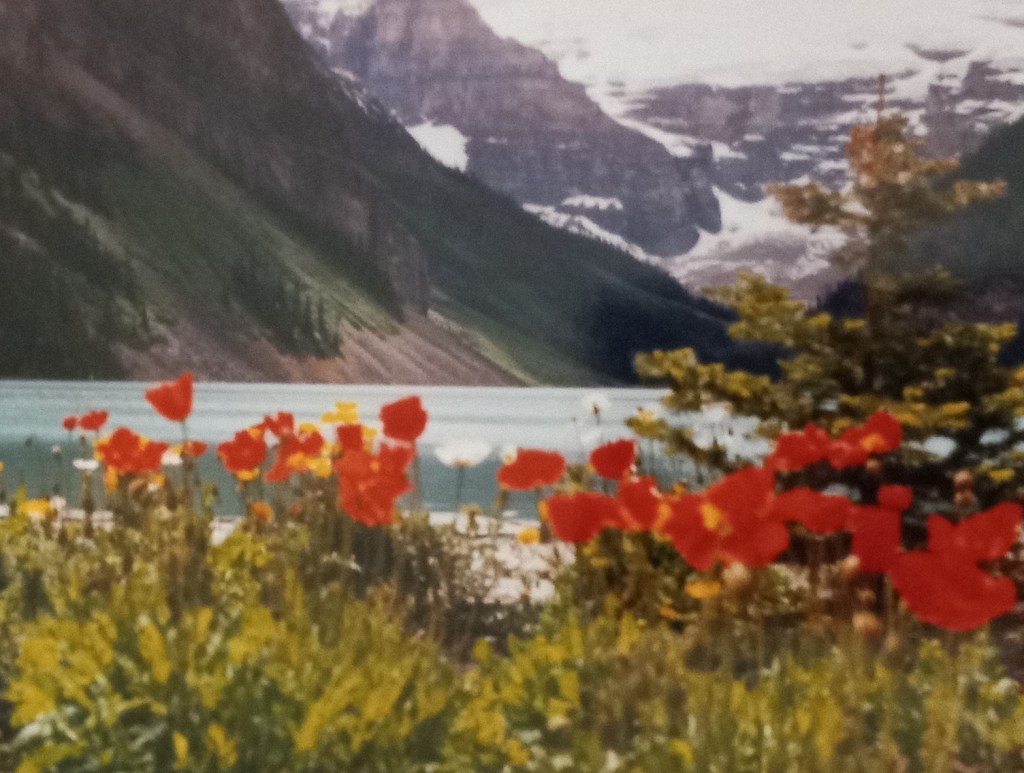
In 1989 I visited Lake Louise, and the reason I took this photo was due to the vivid poppies against the teal blue lake. I would like to paint the poppies and the lake, but I need to do a value study and a color study.
I took a photo of my photo and turned it into grayscale, discovering that the red poppies and the sunlit grass are the same value.
After doing 5 different value studies, I decided to use the lower one of the two, where the number of values is simplified down to three.
I’ve decided to remove the tree at the right — too much clutter, and to remove the snow-covered rocky mountain in the background, making it just (overcast) sky. This is so the flowers will be highlighted.
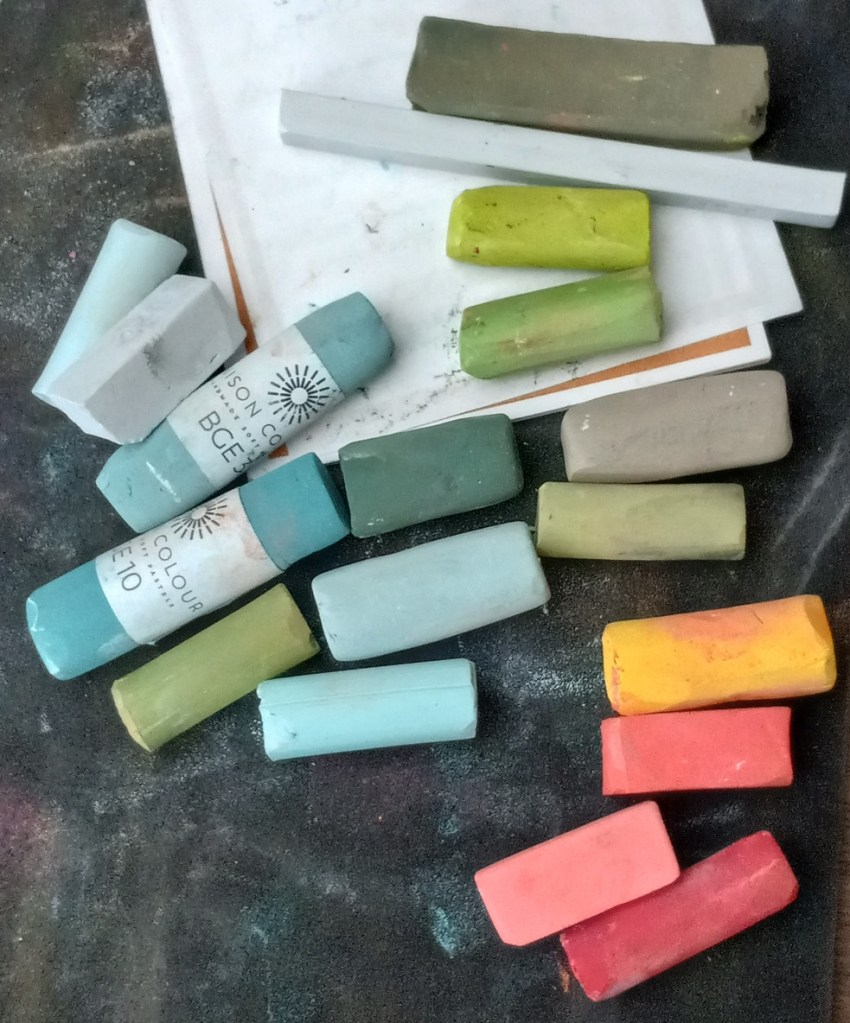
Below I’ve put together a grouping of colors. The mountains are fairly close to the poppies so I want them dark. I need to adjust the sky color, though, and perhaps make it more of a gray purple.
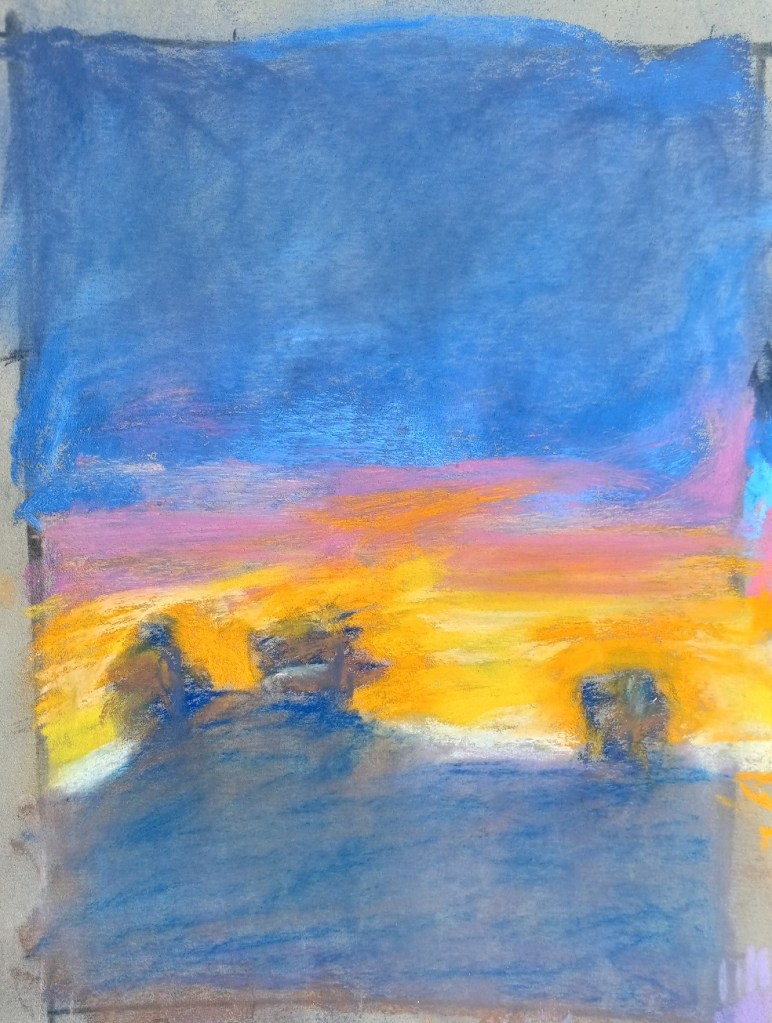
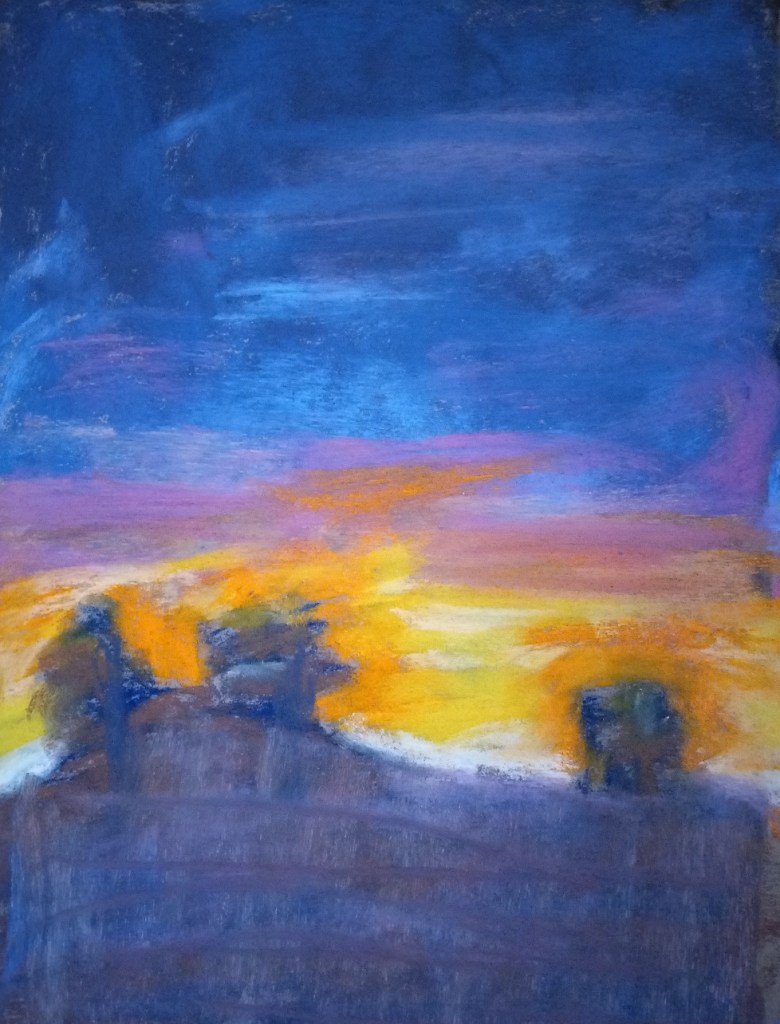
I did the follow-along sunset from Marla Baggetta’s course on the Canson Touch paper and also the Pastelmat paper, without doing any more of the underpainting than the light touch test I did on the papers earlier.
Two of the things I recognized as being at issue with my follow-along painting from Marla Baggetta’sSunsets in Pastel course are: my heavy touch (which led to “mud”) and my poor job at the underpainting. The original picture is below on the right. To counteract the muddiness, I experimented with removing excess pastel in the ground area as well as the upper sky by using an inexpensive bristle brush.
The brush-off showed yet another problem — the underpainting which amounted to nothing more than a scribble. I should have done a wet wash, or a dry wash and not leave the scribbles!
That said, another thing was that I used the Blue Spruce NuPastel on Pastel Premier paper (320 grit); I had difficulty moving the hard pastel around.
So I decided to make a second attempt at the scene, being careful to keep a LIGHT touch.






 BetterLateThanNeverArt