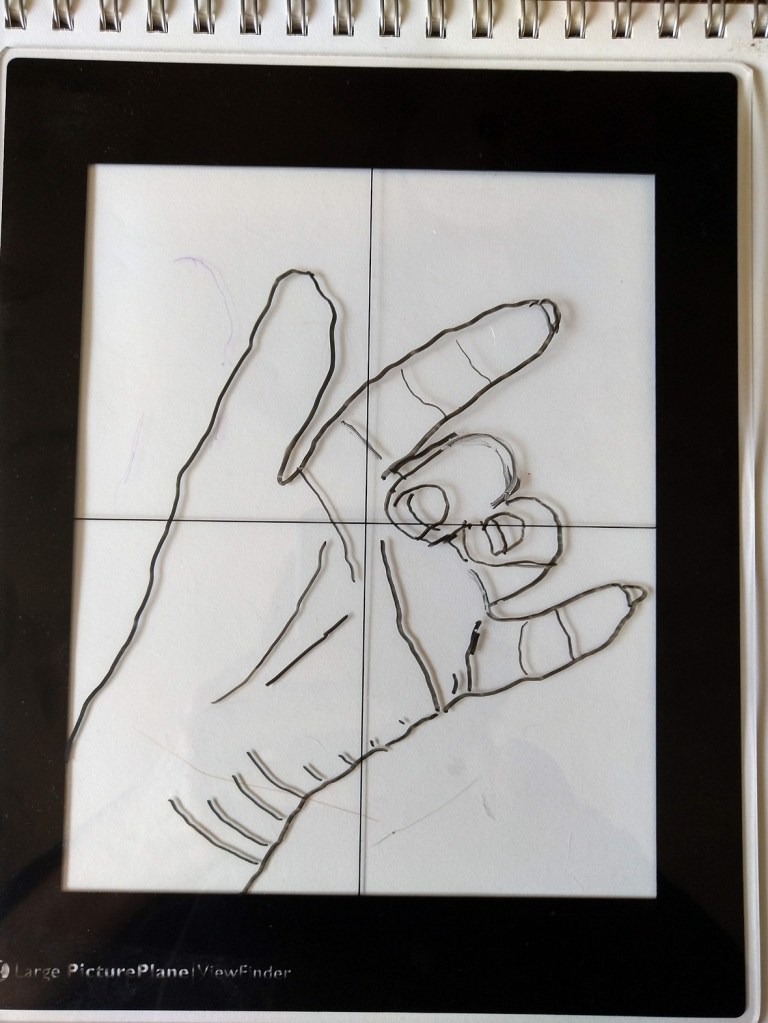
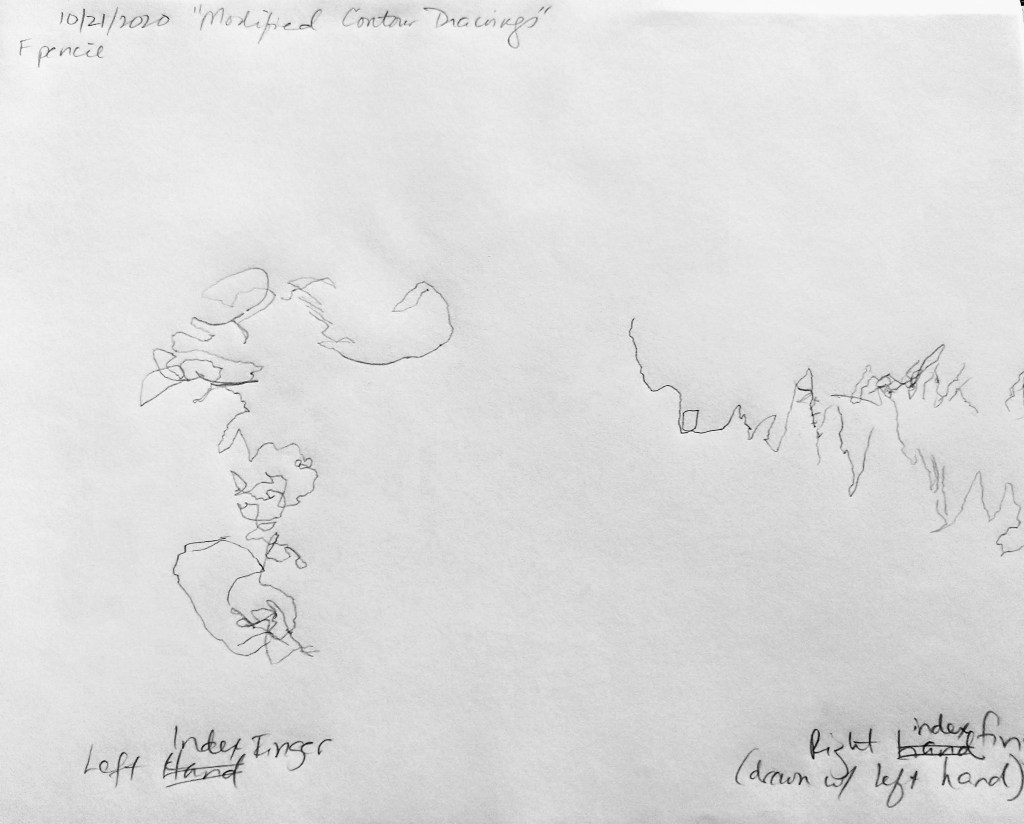
Above, on the left, are “modified contour” drawings of my left index finger (and all its associated wrinkles) and my right index finger (yes, drawn with my left hand). Betty Edwards discusses this kind of drawing in her book Drawing on the Right Side of the Brain (4th edition). The drawing on the left I did years ago and is (my attempt at) a “gesture” drawing of cabernet sauvignon based on Kimon Nicolaides’ posthumous book The Natural Way to Draw. The artists in the various books I have all say different things about contour drawing (and gesture drawing, when applicable).
Garcia and Purcell
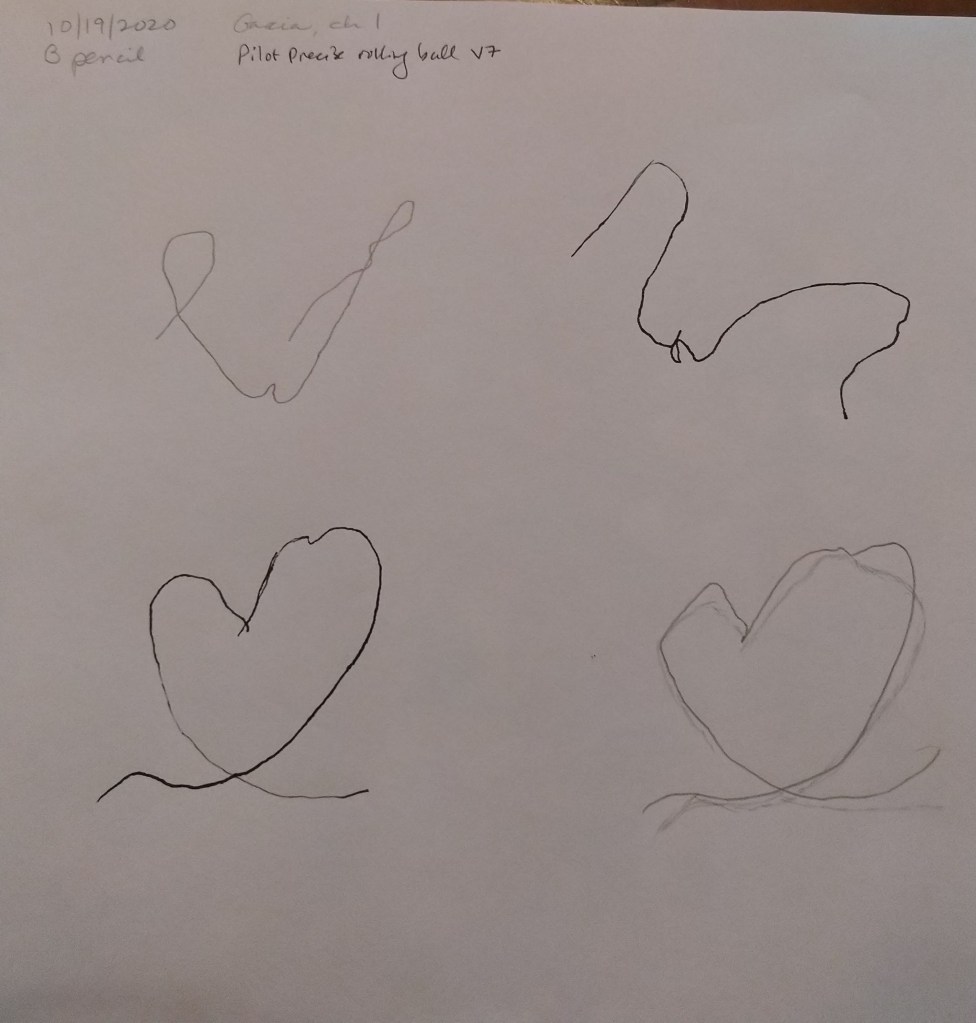
Garcia, on p. 26 of Drawing for the Absolute and Utter Beginner, Revised (15th anniversary ed.), doesn’t specifically define contour line drawing but says you need to study your subject first, and that you should draw slowly, use long firm lines and “turn all crisp edges into line”. She does not mention gesture drawing at all.
Similarly, Purcell in Your Artist’s Brain discusses contour drawing on p. 50-51 of his book, and has a similar viewpoint to Garcia. He also does not mention gesture drawing.
Dowdalls
In Drawing School: Fundamentals for the Beginner, Dowdalls delineates between the two methods of drawing, saying, “Gesture drawing is a very quick, all-encompassing glimpse of the subject. Contour line drawing is a slow, methodical, detailed observation of the subject.” He finds both methods useful.
Nicolaides
In The Natural Way to Draw, Kimon Nicolaides takes a completely different approach. He says on p. 15 of his book that, “In contour drawing you touch the edge of the form. In gesture drawing you feel the movement of the whole.” He says in gesture drawing you should draw what the object is doing, and that it may not even look recognizable to someone when you are done. (And, in fact, they do look like scribbles.) In fact, he argues first for a focus on gesture drawing, and feeling the energy of the subject well before doing any more realistic drawing, saying, “Gesture is movement in space. To be able to see the gesture, you must be able to feel it in your own body… IF YOU DO NOT RESPOND IN LIKE MANNER TO WHAT THE MODEL IS DOING, YOU CANNOT UNDERSTAND WHAT YOU SEE. If you do not feel as the model feels, your drawing is only a map or a plan.” (p. 15-16)
Edwards
Betty Edwards discusses Nicolaides in chapter 6 “Perceiving Edges” of her book Drawing on the Right Side of the Brain (4th edition). She indicates that she uses a “variation of Nicolaides’s contour drawing method that is somewhat more drastic. I’ve called the method ‘Pure Contour Drawing’.” Her “pure contour” drawing has similarities to Nicolaides’ gesture drawing in that the results (say, in drawing your hand without looking at the paper) end up looking similar to scribbles.
But her “pure contour” is more of a deep meditation on the subject –if drawing your hand, for example, you draw every single line and wrinkle you see – while Nicolaides gesture drawing has more obvious energy, even with a seemingly static subject like a lighthouse.
Edwards believes drawing of this sort is “the best exercise for effectively and efficiently enabling students to later achieve good drawing.” When she has skipped this exercise because the students hate it, she has found the students don’t do as well later in the course. She speculates that pure contour drawing “permanently change[s] your ability to perceive” perhaps because the analytical, categorizing, naming mode of your brain “drops out”, leaving the nonverbal, spatial mode to take over.
Having done the exercises in Edwards’ book, I can speak to it being intensely restful, a plus for these covid-19 times. It sure beats coloring, and if it helps me to see and perceive more deeply the objects right in front of me, that is all to the good.






 BetterLateThanNeverArt