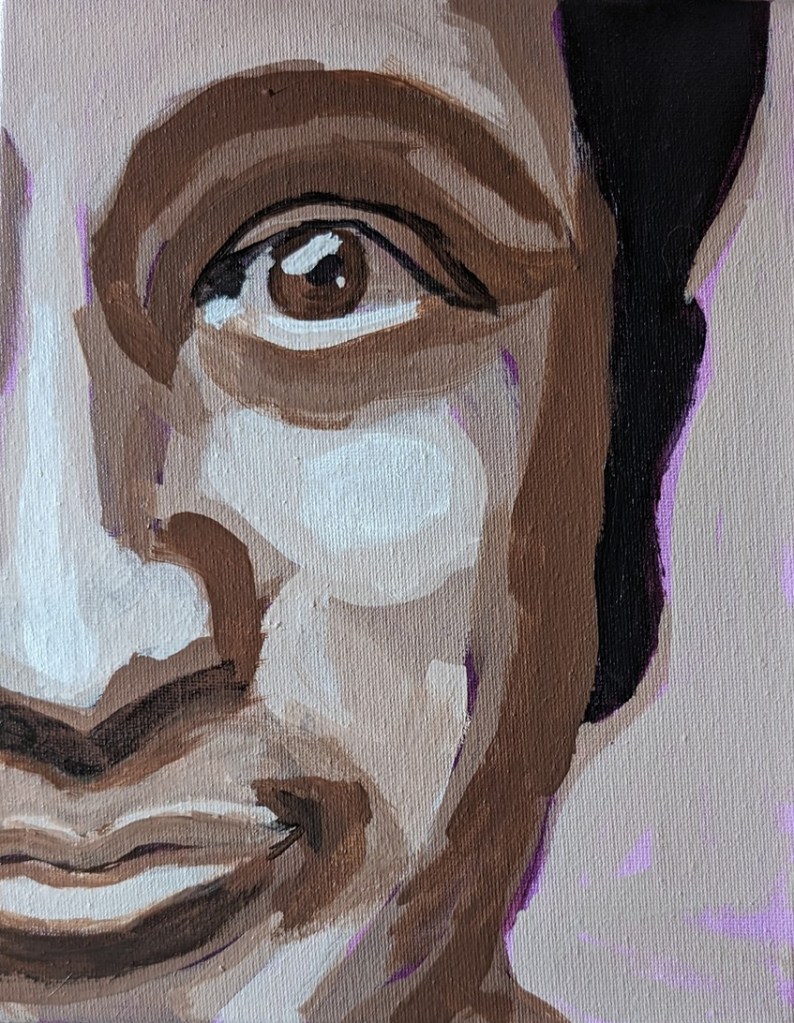
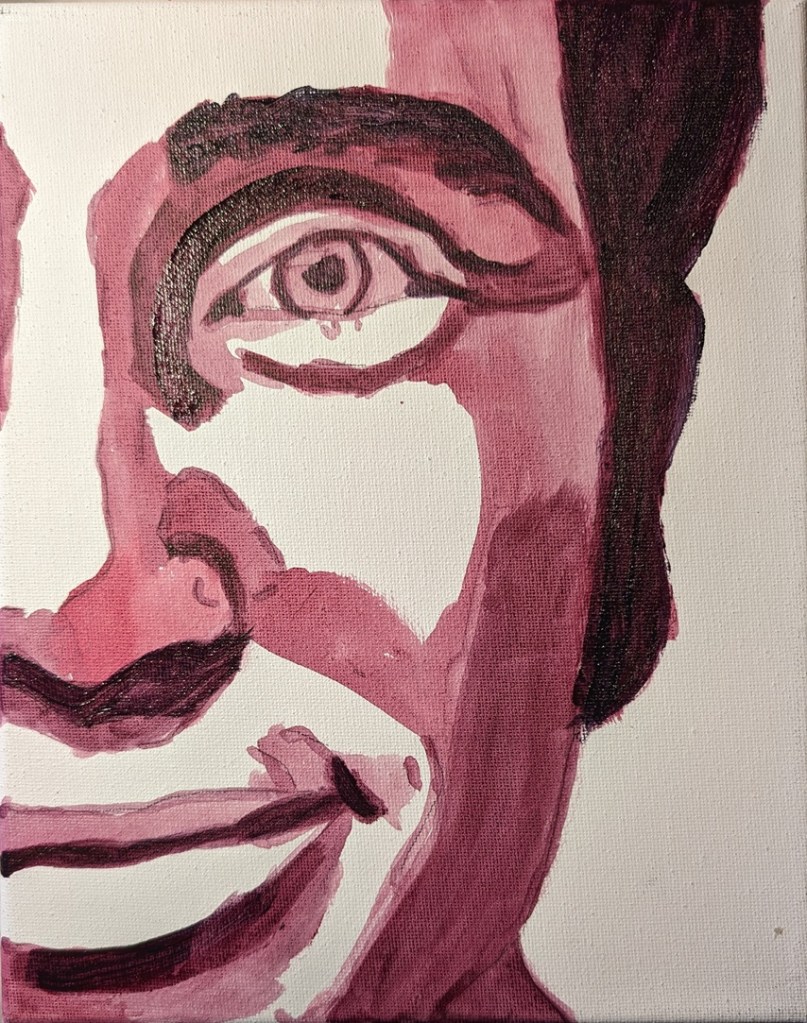
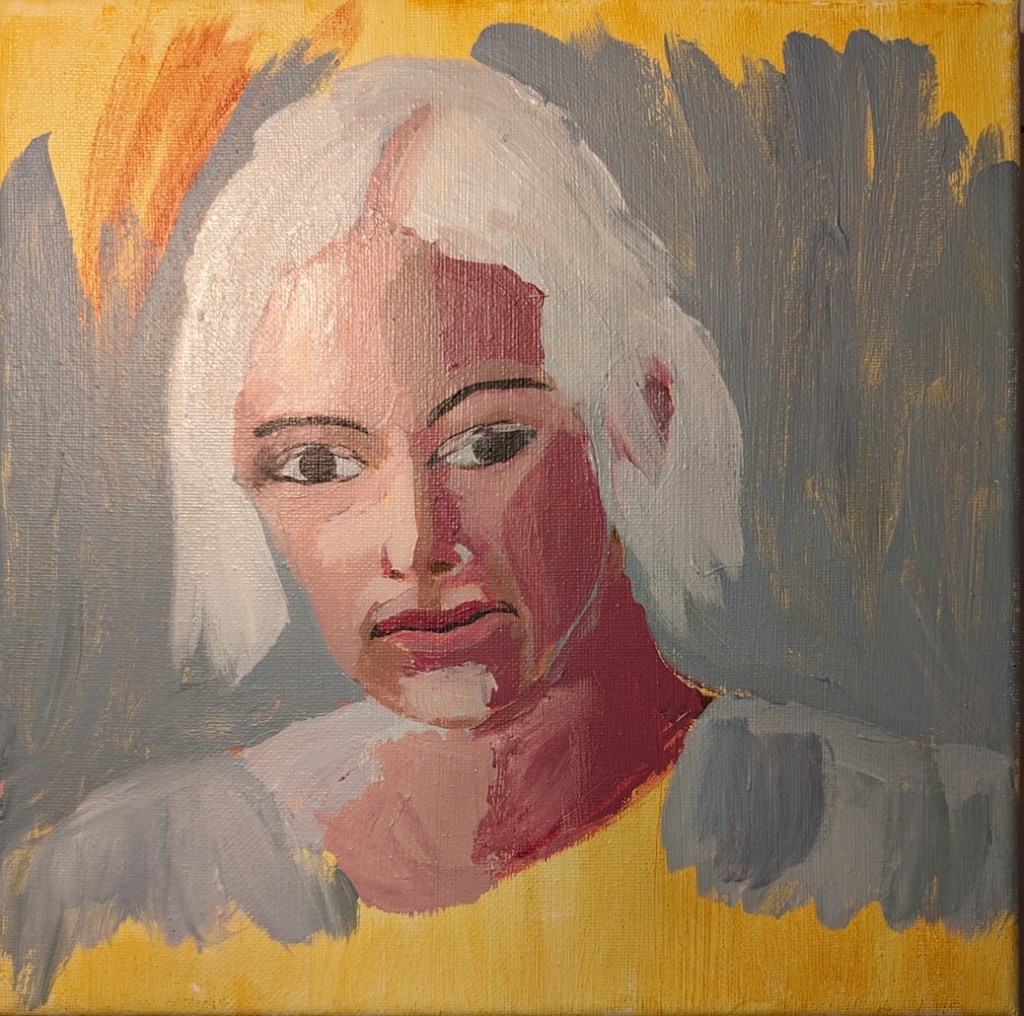
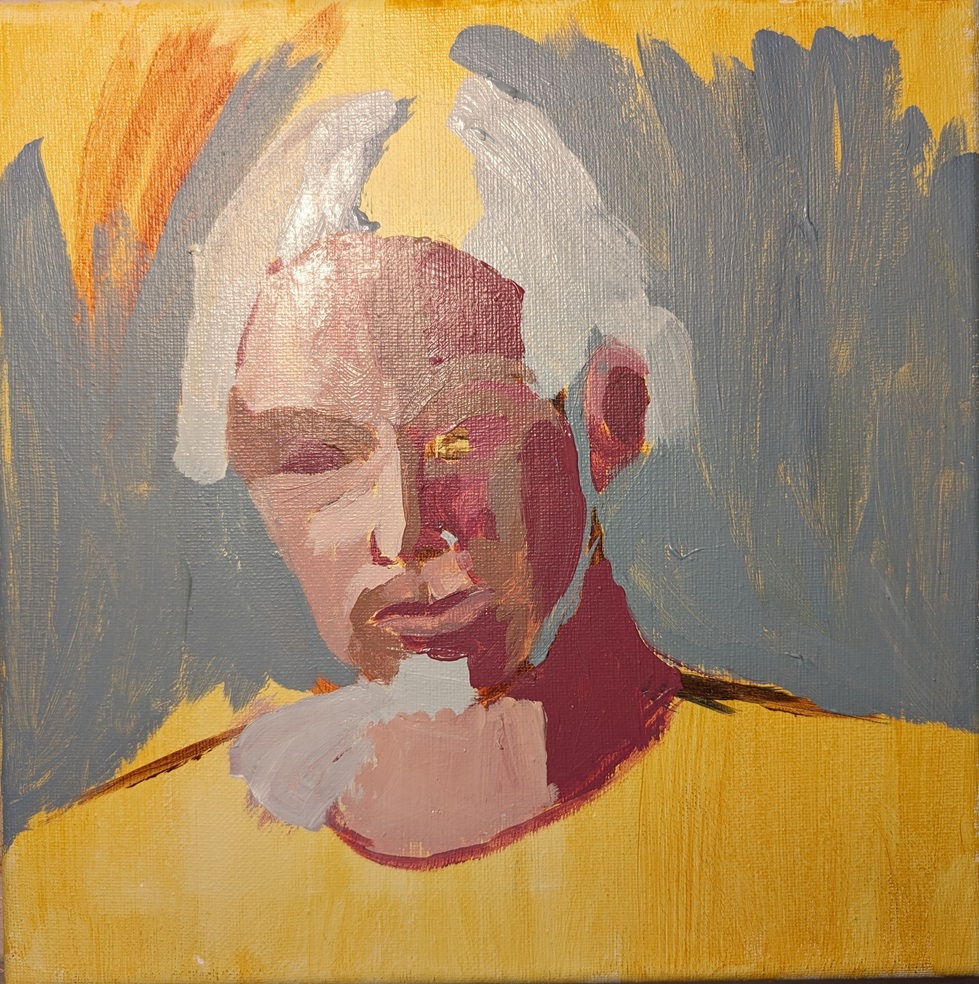
As I said in my last post, I did end up going back and modifying my painting from the 4th weekly exercise of Let’s Face It 2026 (taught by Laurie Johnson).
My goal was to blend the paint more thoroughly in the face so that there wasn’t such a harsh change from light to shadow. The new version is on the right.
I did this portrait in acrylic on an 8×8 canvas panel as a part of the 4th weekly exercise of Let’s Face It 2026. It was taught by Laurie Johnson. I modified the reference photo in Adobe’s Photo Essentials, using the “Cutout” feature (set at 4) to make the skin shading lines. (Now I need to blend better!) I am thinking of redoing the whole thing. We’ll see. (In the meantime, she looks better in miniature.)
I painted this dog on the sofa based on a reference photo by Alyssa Fleischer, part of a January 2022 “painting party” at Acrylic University. It is also viewable on YouTube here.
This was painted on an 8×8 canvas panel. The dog was done in Titanium Buff (aka Unbleached Titanium (PW 6:1) and Burnt Umber. For the window panes I used the same — but added a touch of Mars Black. (I am going to go back and redo the panes, painting with a straight-edge 🙂
The greenery base was Chromium Green with some Ultramarine Blue, Titanium White, and Cad-free Yellow Light. The sofa I painted using Liquitex BASICS blue-gray and since it’s a “student” color, it darkened a whole lot after drying, but I think I’ll leave it as is.
I was drawn to this photo of a blue jay on a snowy branch over a year ago, and the 9×12 canvas has sat toned and drawn out waiting for me to paint it. That day was today.
The bird colors are Ultramarine Blue, Phthalo Blue Green Shade, Burnt Umber, Titanium White, and Mars Black.
Earlier in January I watched a paint-along by Jed Dorsey of Acrylic University for their Bloom Membership level. He painted this scene from one of his own photos, and his painting was striking in its use of color, reflecting a golden sky from the sun setting behind the trees in the distance.
I was all set to try that myself. But when I downloaded the reference photo and a photo of his painting, on a whim, I set the saturation to zero — and found I absolutely LOVED the black and white version. So I decided to try painting it to play with the values.
This was done strictly as a study, on an 8×8 wood panel that I had gessoed a while back. The sky, in fact, is simply the white gesso. (It’s more yellow here in the photo than it is in real life.) I deliberately painted the snow thick just for the heck of it.
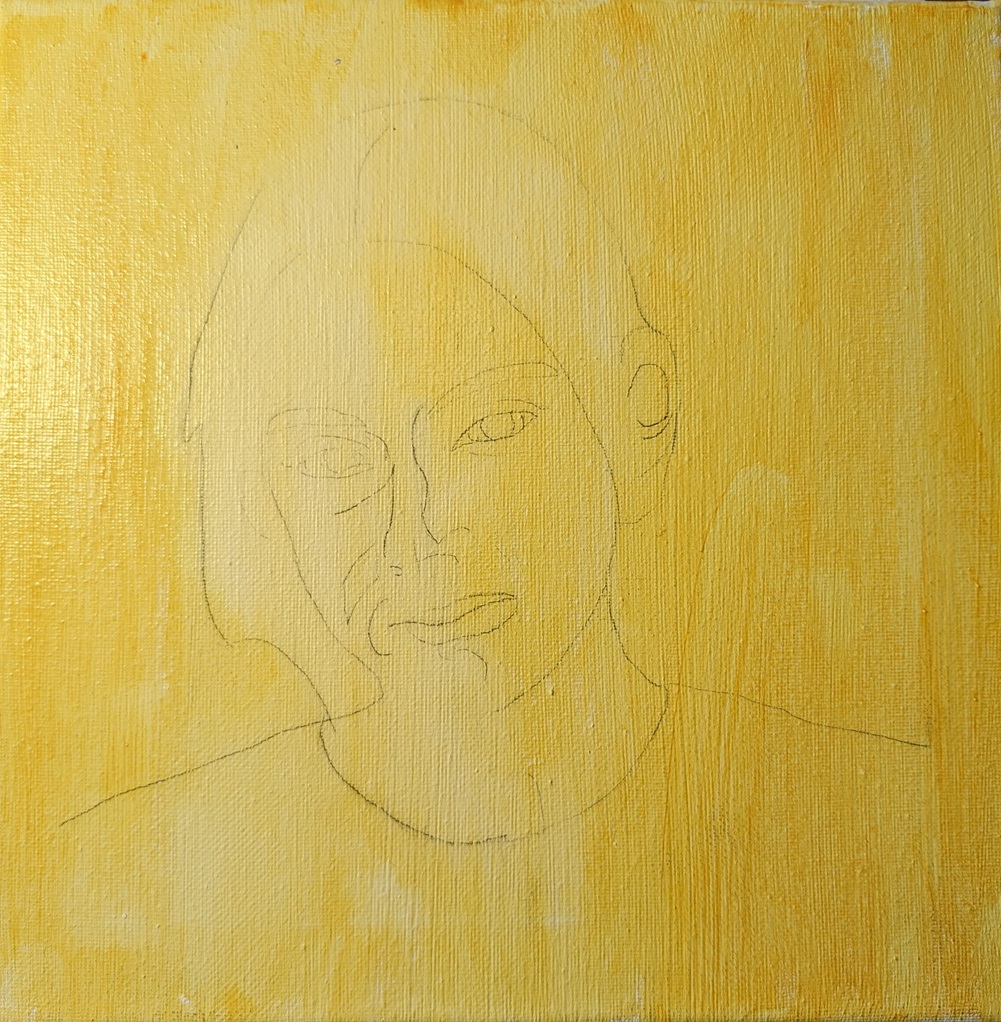
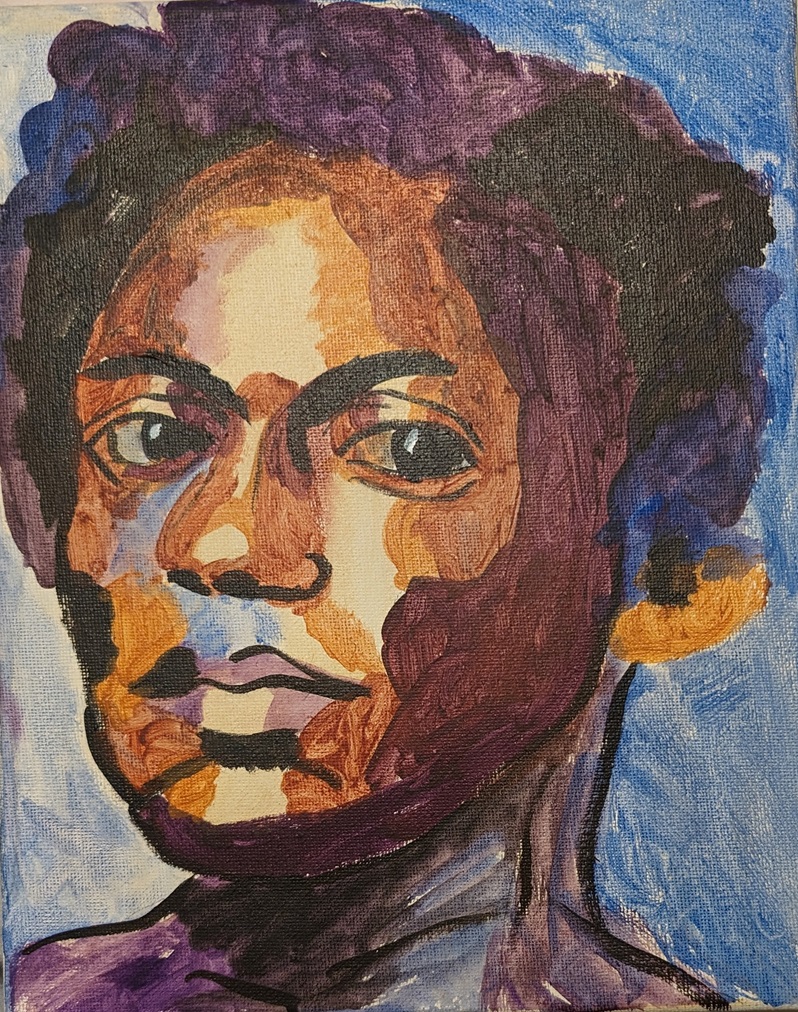
A year ago I signed up for Let’s Face It 2025, a 52-week series of portrait lessons which you can either follow along with or use as inspiration for your own fully original art, but I never did a single exercise. This was Week One and it was taught by Kara Bullock.
I have yet to complete any of the years I bought (2023 through 2025) although I just signed up for the 2026 version, but there are actually only a few weeks in each of the years which interest me, and they’re on my to-do list.
This one was done on an 8×10 canvas toned in quinacridone rose (PV 19), and I don’t have the photo credit information, but am guessing it’s on Unsplash or Pixabay. “In progress” photos are below. I used a lot of Burnt Umber, Raw Umber, Titanium White, and a crimson color (PR 264).
For what it’s worth, I’m done with this painting from Acrylic University‘s 2024 Summer Challenge based off a photo by Doug Greenman of a Puerto Rico beach.
I’m not super excited about it. I don’t like the orange — but come to think of it, I really didn’t like the magenta tone on the board to start with. (Maybe I should’ve started by painting over that!)
One thing I AM happy with is the father and child figures, and their reflection.
I am working on a painting from Acrylic University‘s 2024 Summer Challenge which Jed Dorsey painted using a photo by Doug Greenman of a Puerto Rico beach.
The first thing I did was crop the reference photo fully square and reduce the contrast significantly, as well as brighten so that the sky and sea look mostly orange.
I am using an 8×8 wooden panel which I had toned in a magenta color months ago, The cliff, the distant shore, and the reflections of the figures are all painted in shades of Raw Umber & Titanium White. Then I added Ultramarine Blue to that mixture to paint the sand, the bank of low dark clouds above the horizon, and the wisps of clouds above. The bright spot is a yellow and white mix; the orange is Naphthol Crimson, Cad-Free Yellow Light (Liquitex) and white.
This is a redo of the week 12 painting for Jed Dorsey’s Mini Painting Challenge at Acrylic University, based on my observations of mistakes I made in the original painting. The idea was to get the proportions more accurate, the perspective/distance more accurate, and to convey a better sense of form (namely, that the trees were at the top of and behind a hill).
I painted it on a 5×5 canvas panel. For the sky I used Liquitex Soft Body Light Blue Permanent (PB15, PG7, PW6) and mixed the lower latitudes with more white. The pine trees were painted with Atelier’s Forest Green (PY74, PB15.3, PR101) mixed with Phthalo Green (Blue Shade) and Ultramarine Blue. The darker grass was a mix of Atelier’s Forest Green with Cad-free Yellow Medium by Liquitex, and the lighter grass was a mix of Winsor’s Sap Green (PY74, PG7, PBk7, PW6) and Cad-free Yellow Medium.
Here is a comparison between the original I two years ago, and the one I did today. The newer painting is far from perfect — the trees are still wonky, the paint is gloppy on the trees and I think the grass should be lighter in value — but at least you can tell the trees are on a hill, and the rocks no longer “float”.
Here are some in-process photos of the redo:
Here’s a value comparison between the reference photo [credit: Mark Hadland] and my painting.