Joke’s on me. I posted the wrong “final” version earlier. This one, with the lights, is the final of “Winter Cabin”. For better or worse. Onward!
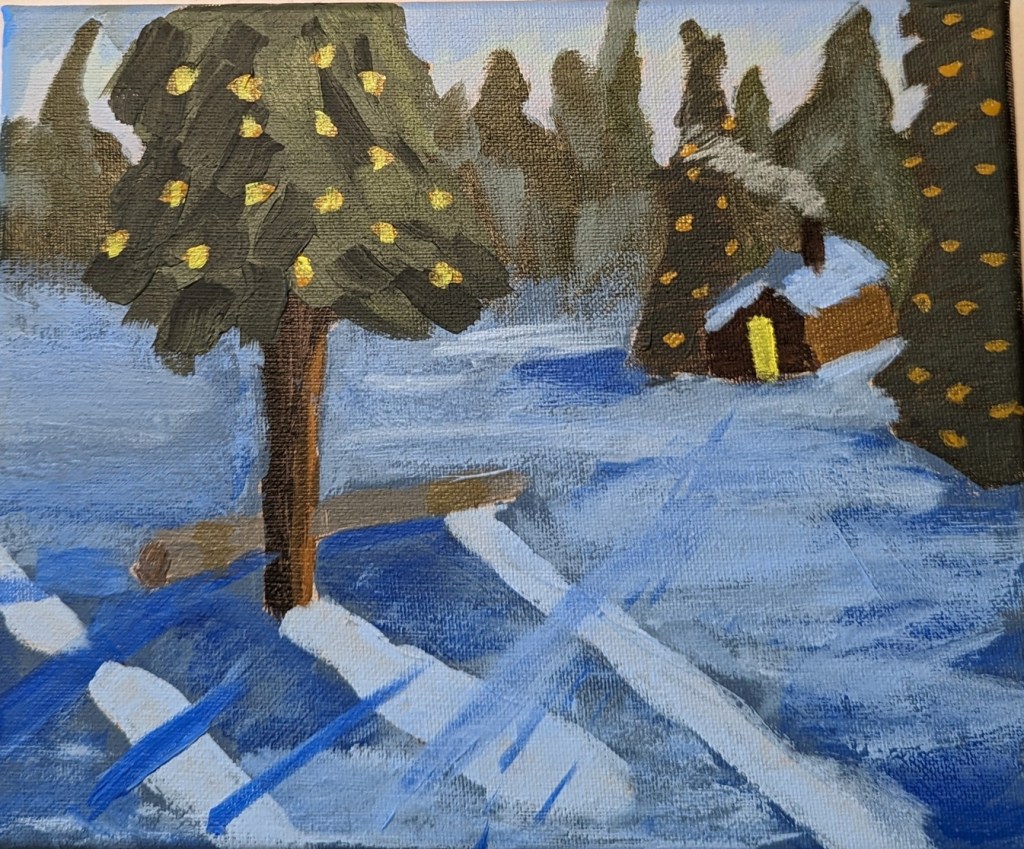

Joke’s on me. I posted the wrong “final” version earlier. This one, with the lights, is the final of “Winter Cabin”. For better or worse. Onward!
As I indicated in an earlier post, I’m working on “Winter Cabin” in a follow-along from a PaintCoach post on Patreon.

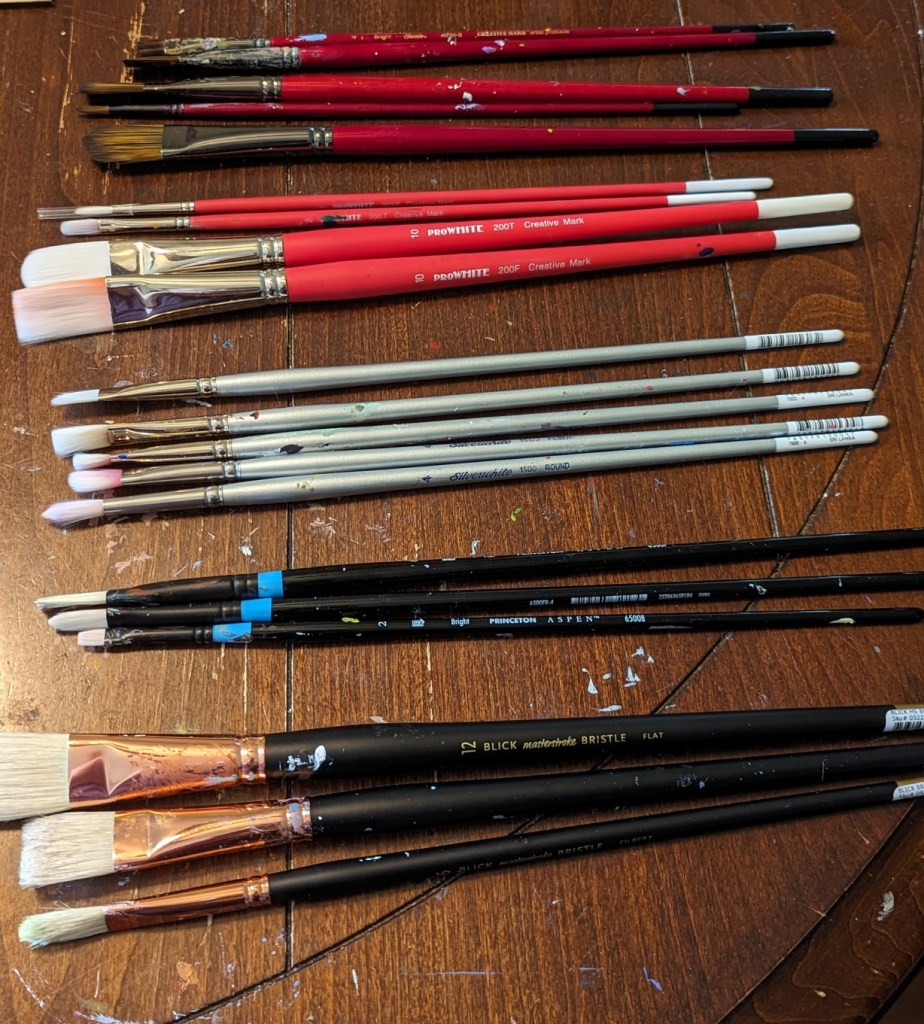
As a beginner, I really had no idea what to buy as far as brushes were concerned, and also it was more important to me to go with high-grade paint. Brushes are a lower priority. I also heard that every brand uses their own sizing so that a “4 Flat” is not the same size across vendors (which I have since found — by buying different brands — that is not exactly true.)
So, based on the photo below, the closest brushes to the camera are from Blick and they’re hog bristles. In my beginner hands, and because I bought the bigger sizes (10, 12) I find them somewhat difficult to use. Currently I use them mainly to paint base coats on to my canvases. (I don’t ever use them for painting gesso coatings — I have a set of cheap Blick utility brushes for gesso.) They are very easy for me to clean with dishwash soap.
The Princeton Aspen brushes are synthetic; they feel somewhat “plastic” to the touch — that is something I like. The little brush is a “2 Bright” which is just too tiny for me, but I like the other two very much. Very easy to clean either with dishwash soap or The Master’s Brush Cleaner & Preserver.
I bought the Silverwhites at Jerry’s Artorama. I don’t use them much — that the bristles are white turns me off because they never seem clean. Plus the bristles are super soft.
The Creative Mark Pro Whites have firmer bristles than the Silverwhites, but I have the same aversion to “dirtying” the bristles. I’ve really only used the 10 Flat, which is permanently stained.
Last but not least are my current favorite brushes: the Creative Mark Staccatos. I love the firm bristles, and I don’t have any hang-ups about staining the dark bristles, lol. You can tell from the handles full of paint that I use them constantly, and I prefer the flats to the filberts.
So those are my current thoughts about brushes for acrylic painting, which will likely change in 6 months or so. What brushes do you prefer?
For better or worse, I’ve finished it!
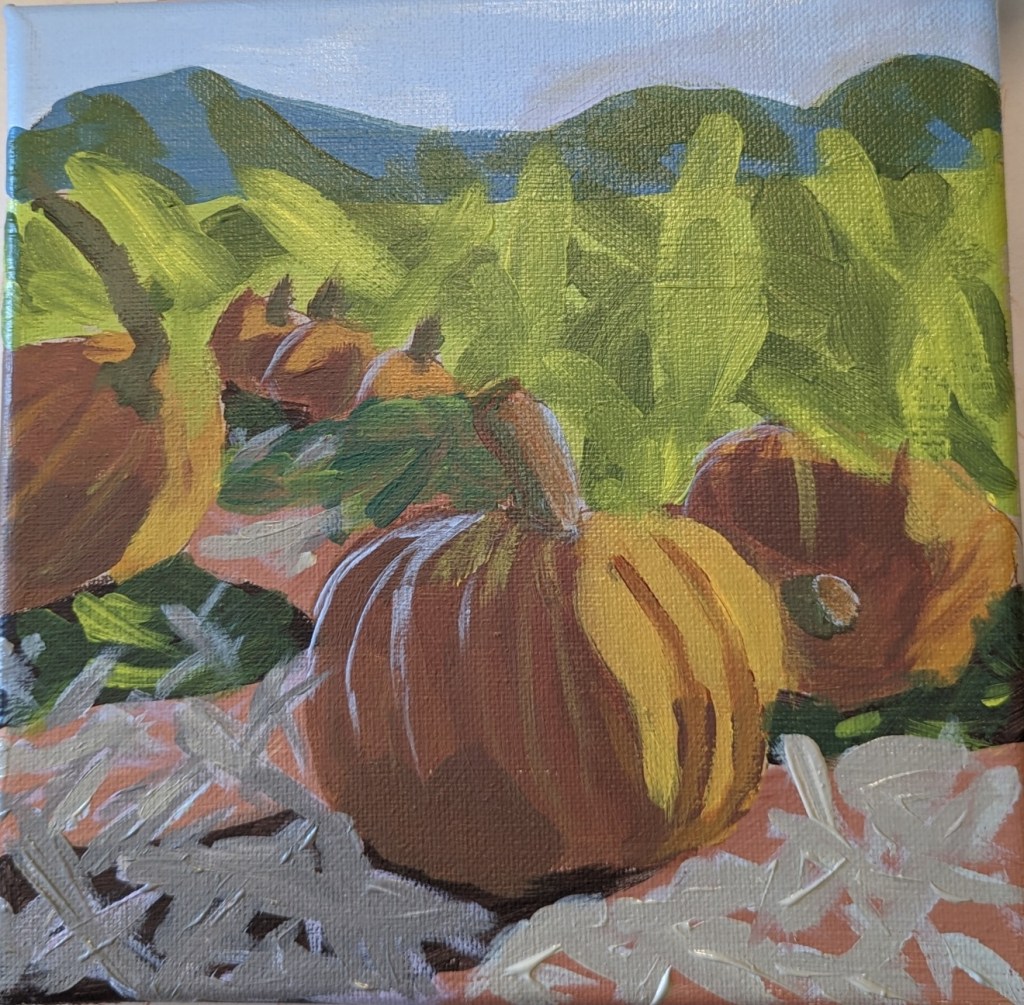
After I completed today’s work, I realized that the center pumpkins were all in a line, and I decided I didn’t like that. Bad composition. (See left image.) So I removed one of the pumpkins, and I think it looks a bit more natural.
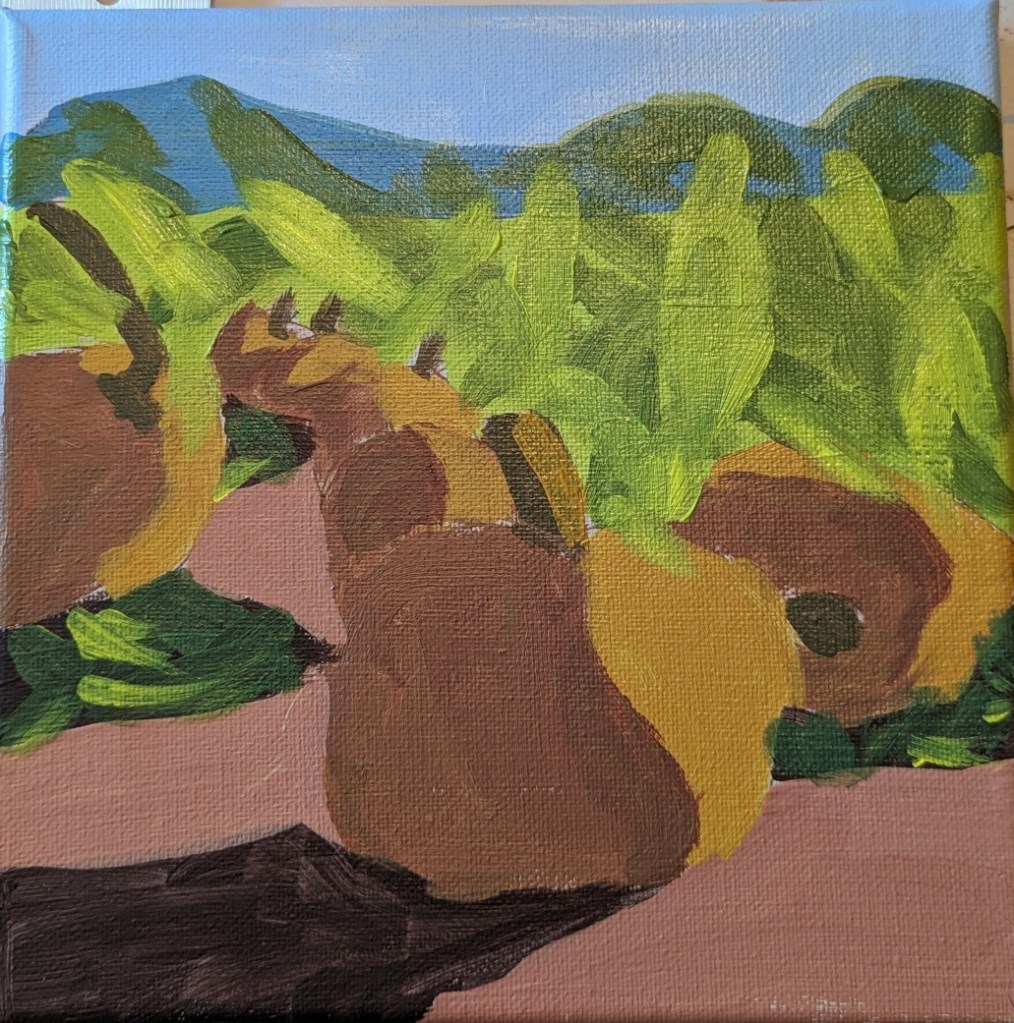
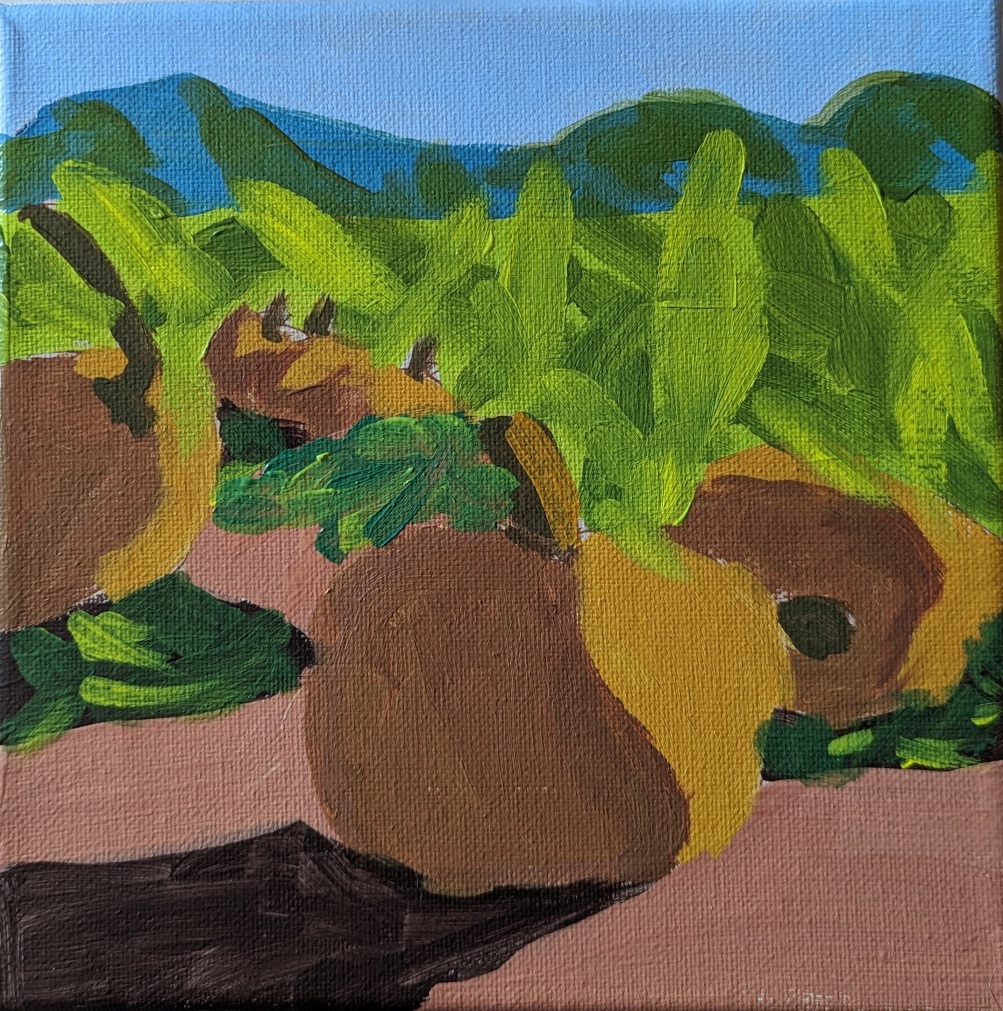
It’s finally starting to feel like fall here after a long, hot summer. So, I’m in the mood for fall-themed paintings. This one is from a lesson for patrons of PaintCoach. The idea is to map out the large shapes first, and get the values set before filling in the detail.
I’m doing this on an 8×8 canvas, which I painted with Winsor & Newton Galeria in Pale Umber, drawing out the lines with an acrylic paint pen. (Some of the lines are “wrong”, but I’ll be painting over them anyway.)
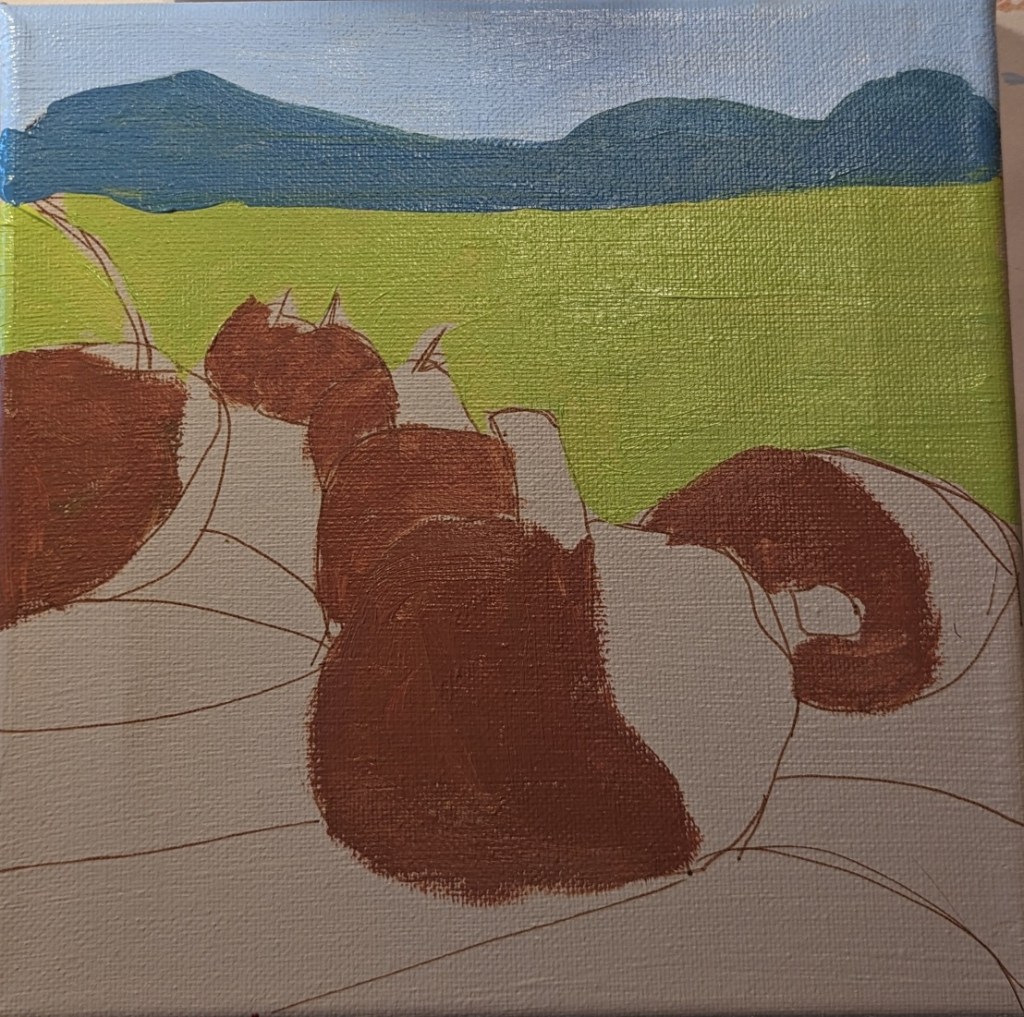

I did these paintings based on a lesson from PaintCoach on Patreon. The first one I did, I barely looked at the photo, and instead was following along with the video. The scene ended up being excessively abstract (top right). The second effort is marginally better, but I’m still not satisfied.



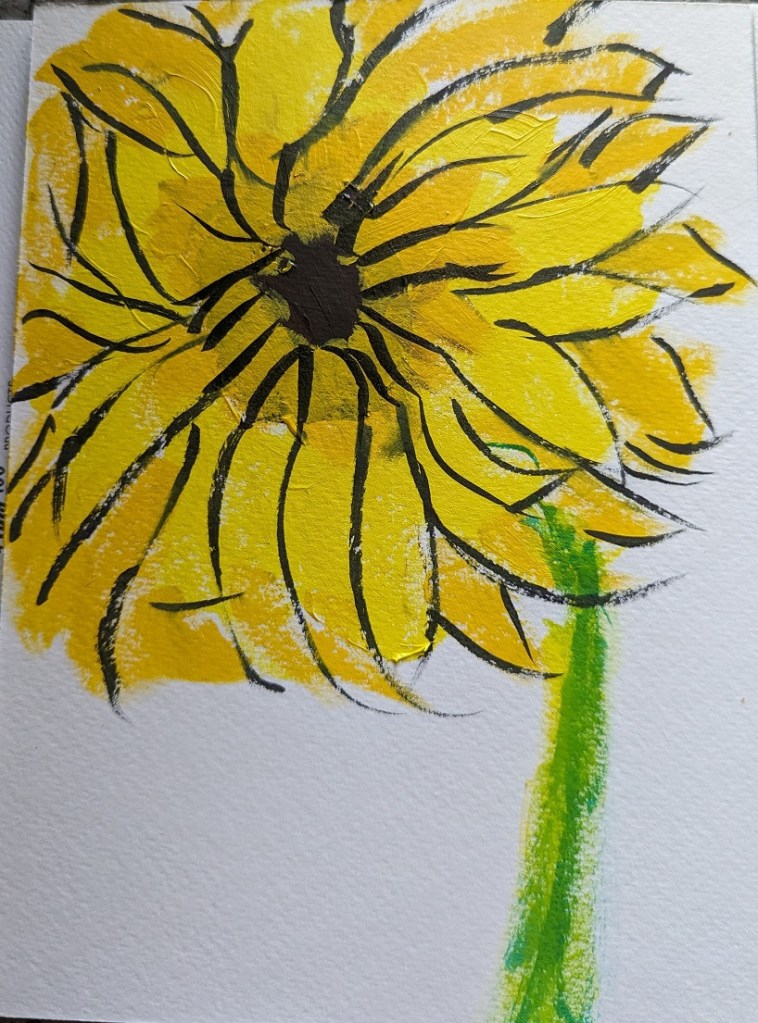
I painted one of the sunflowers in my vase — but skipped the vase. And decided to outline it with one of my Arteza Brush Pens. This was done on 6×8 300-lb. watercolor paper.
The painting below — on 6×8 300-lb. watercolor paper — is based on a photo by Shannon Baldwin on Unsplash; my painted rose leans red as opposed to a peachy coral.

 BetterLateThanNeverArt