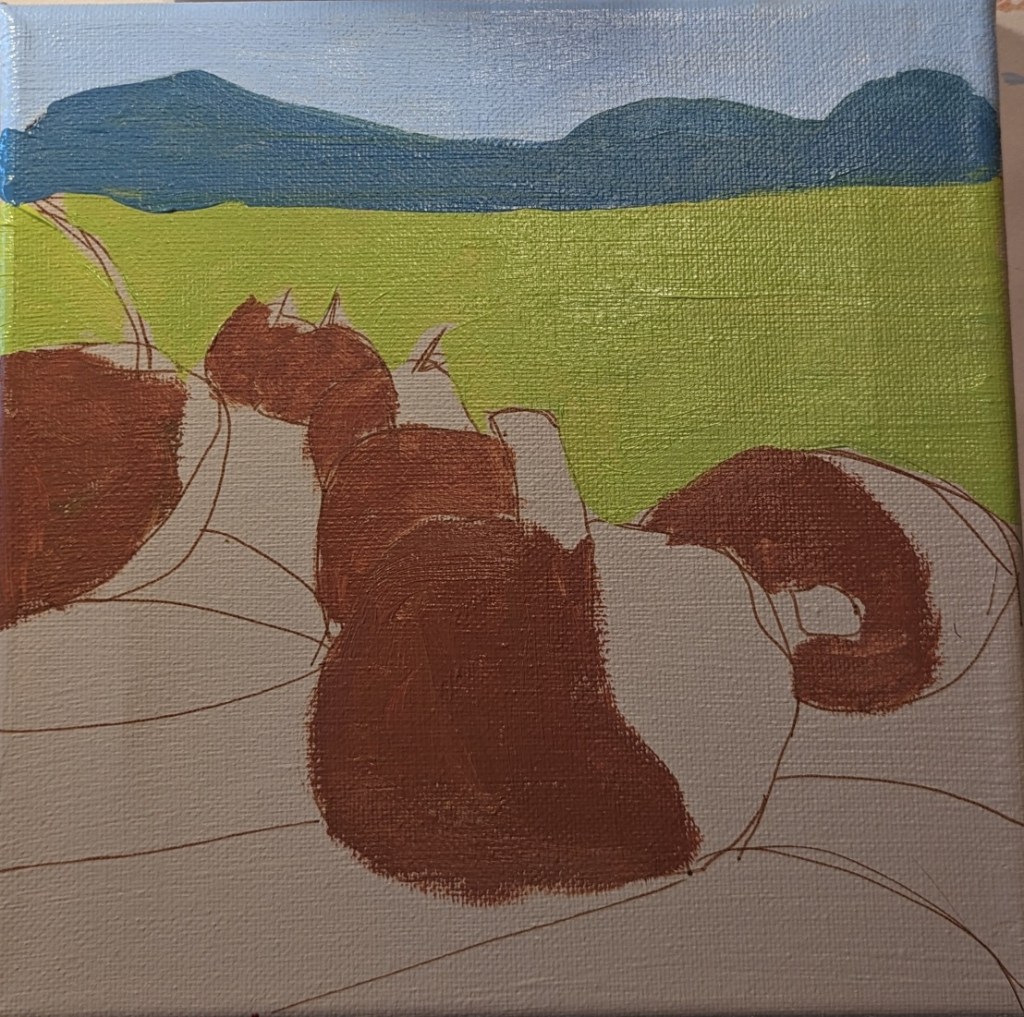
It’s finally starting to feel like fall here after a long, hot summer. So, I’m in the mood for fall-themed paintings. This one is from a lesson for patrons of PaintCoach. The idea is to map out the large shapes first, and get the values set before filling in the detail.
I’m doing this on an 8×8 canvas, which I painted with Winsor & Newton Galeria in Pale Umber, drawing out the lines with an acrylic paint pen. (Some of the lines are “wrong”, but I’ll be painting over them anyway.)
This painting was based off an image by RÜŞTÜ BOZKUŞ from Pixabay, and an article I found on the UK site Painters Online. I used an 8×8 canvas for this work, and took photos of each step I took.
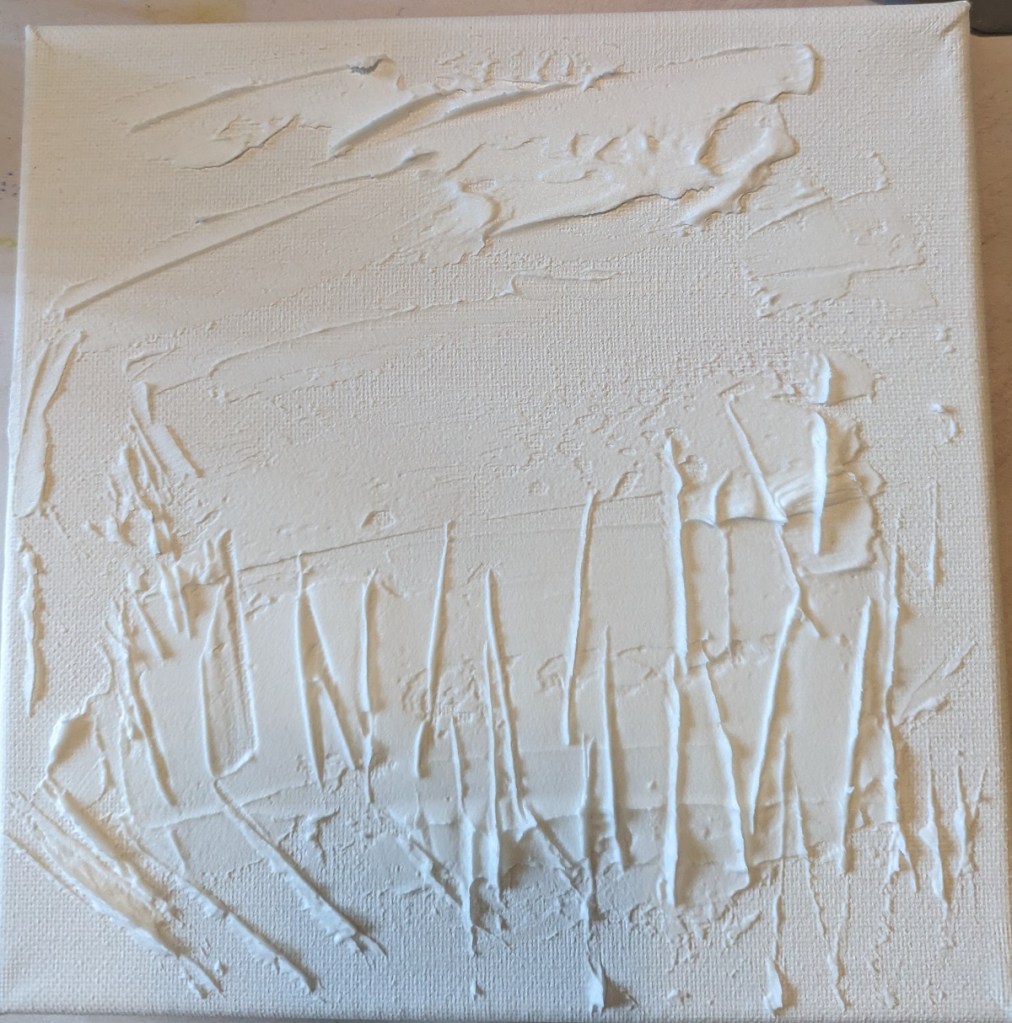
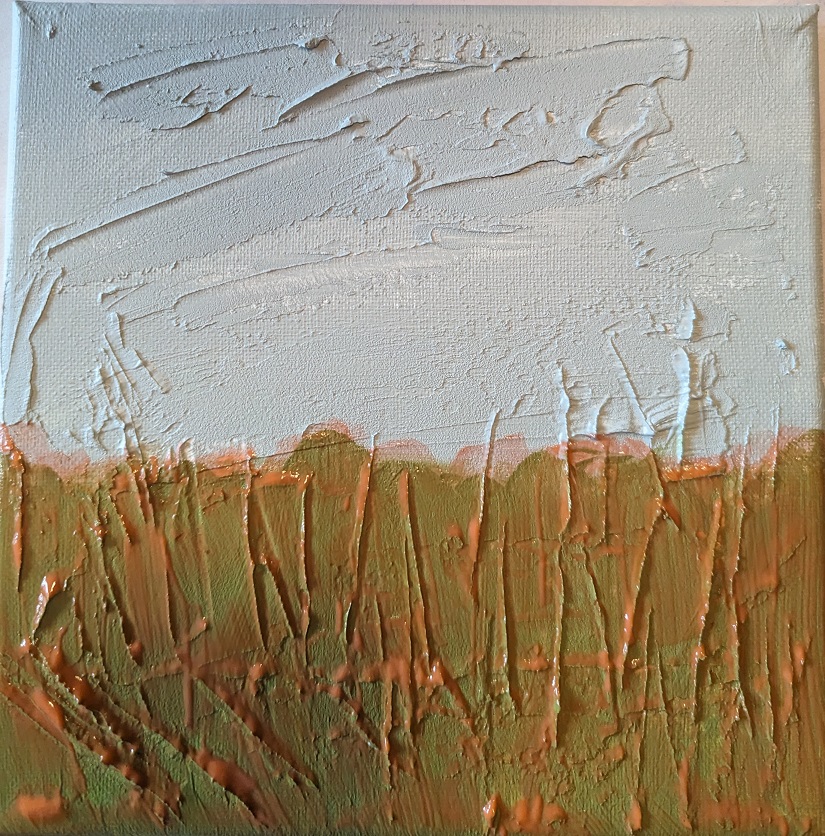
Step One was to apply the modeling paste. The horizontal “goop” was to signify clouds; the vertical lines was to signify weeds and plant stalks.
After applying the modeling paste and letting it thoroughly dry, I went in my own direction rather than following the Painters Online demo.
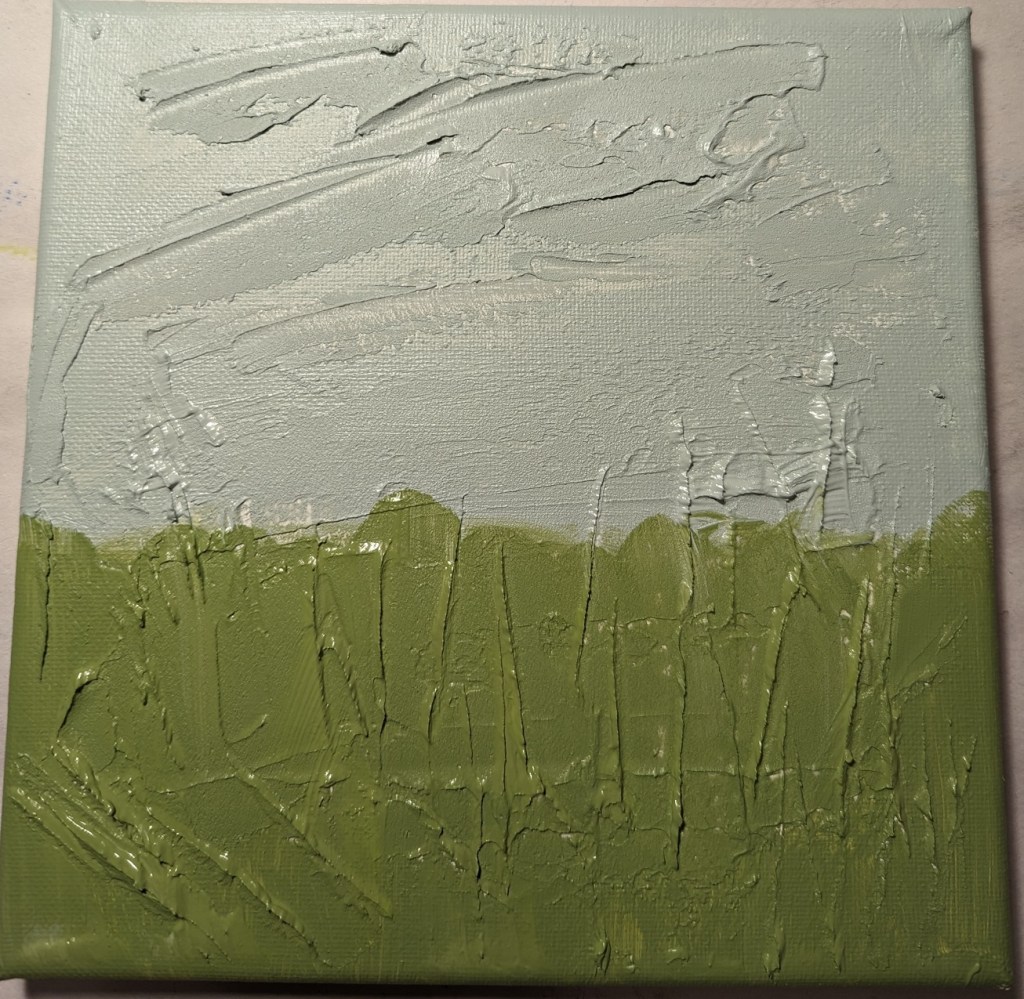
I used a gray green mixed with a yellow green for the grasses, and a gray blue for the sky area.
Green is reportedly not a good color to use alone when doing landscapes and meadows. So, my next step was to apply a transparent orange glaze (using Liquitex Gloss Glazing Medium over the green paint, and let that dry thoroughly.
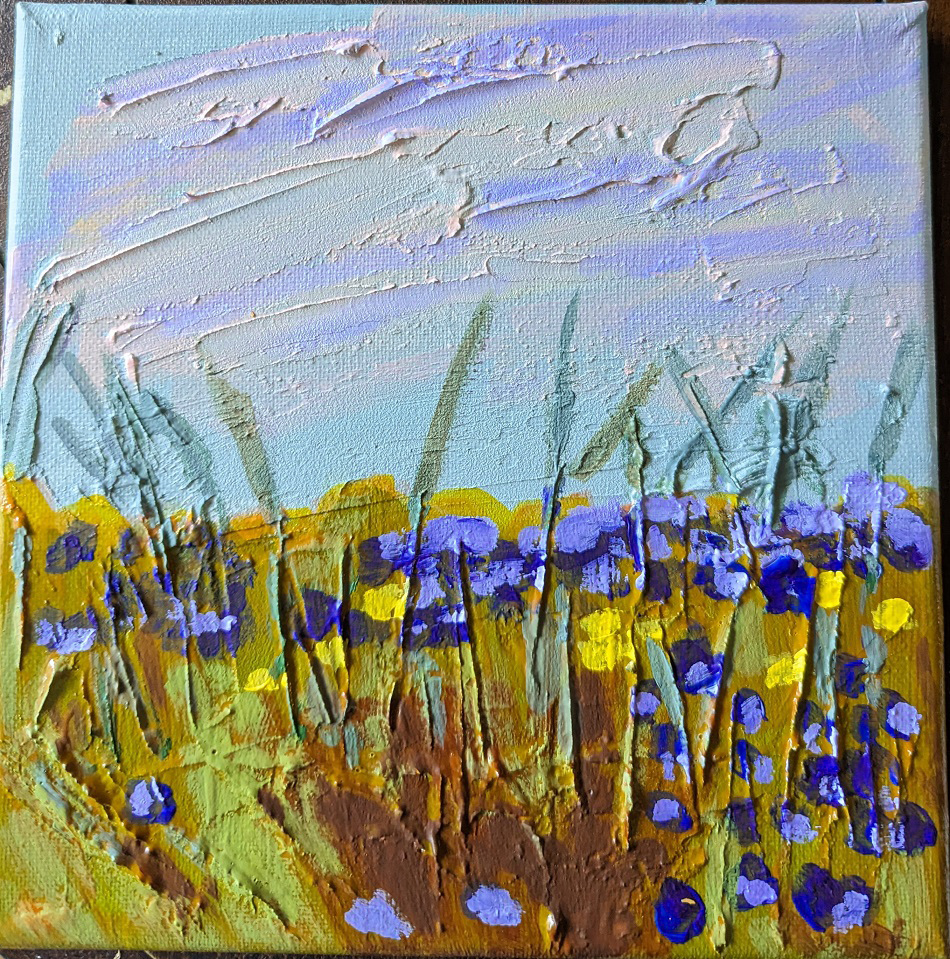
After the glaze dried, I added a darker value in the center bottom (to match with the reference photo) as well as adding a glaze of Cadmium Red Medium Hue for the clouds.
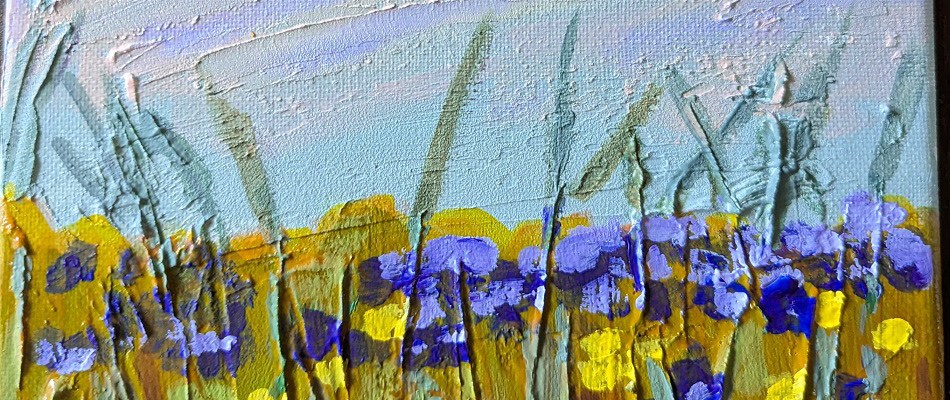
Next I painted the flowers, using Dioxazine Purple with some Titanium White, some yellow flowers, and highlighted the stems with Gray Green, yellow, and Burnt Sienna. I retouched the grassy area with some green. Then I added some of the Dioxazine Purple mixture to the clouds in the sky, and called it a day.
(The photo here doesn’t fully reflect the periwinkle/purple color of the flowers; they look too blue.)
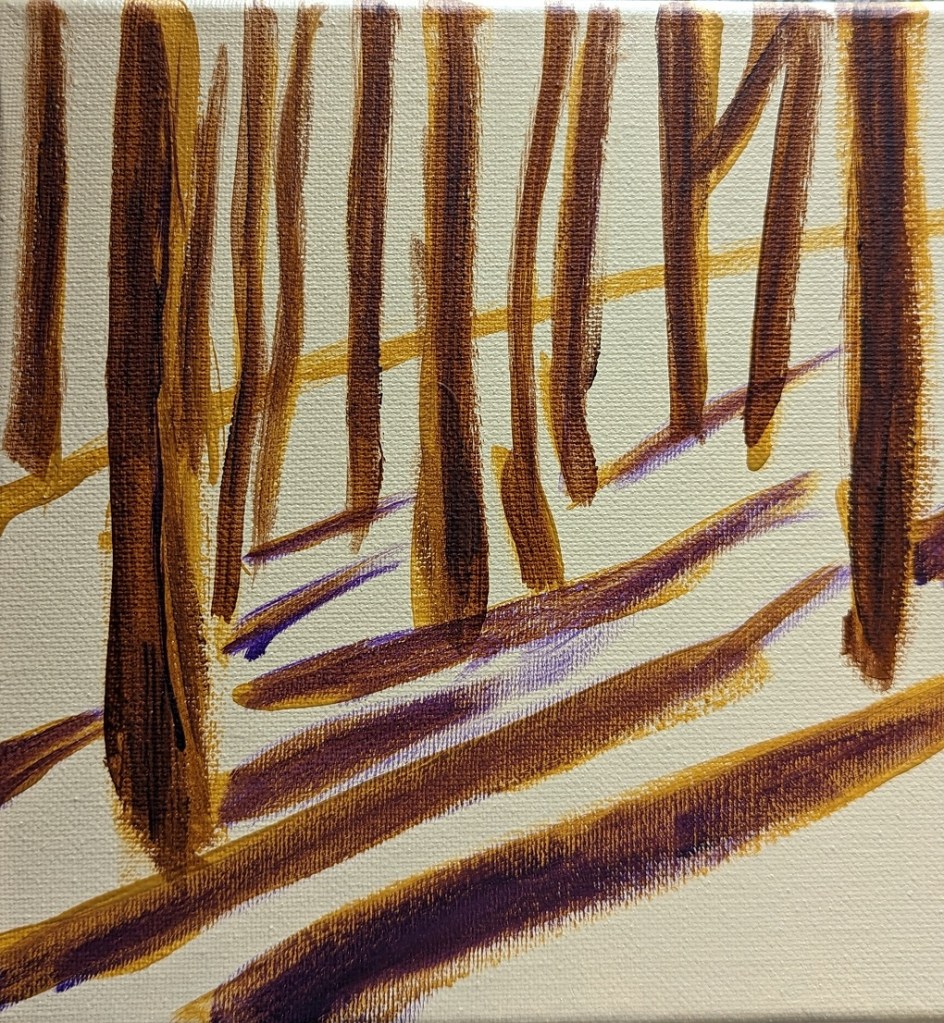
I was browsing through Pixabay and Unsplash for landscape scenes of trees on a hill, and in snow. I was inspired to do this impressionistic work. For the snow, I tinted white with purple, yellow ochre, orange and pale blue. The tree trunks are painted in yellow ochre, burnt umber, orange and purple.
Although I wasn’t too crazy about Mark D Nelson’s “Learn to Paint in Acrylics with 50 Small Paintings”, it DID get me painting. So, I picked up Volume 2, and decided to do my own version of one of his small landscape works.
Mine is painted on a 6×6 canvas, and riffs on Daniel’s effort (also shown).
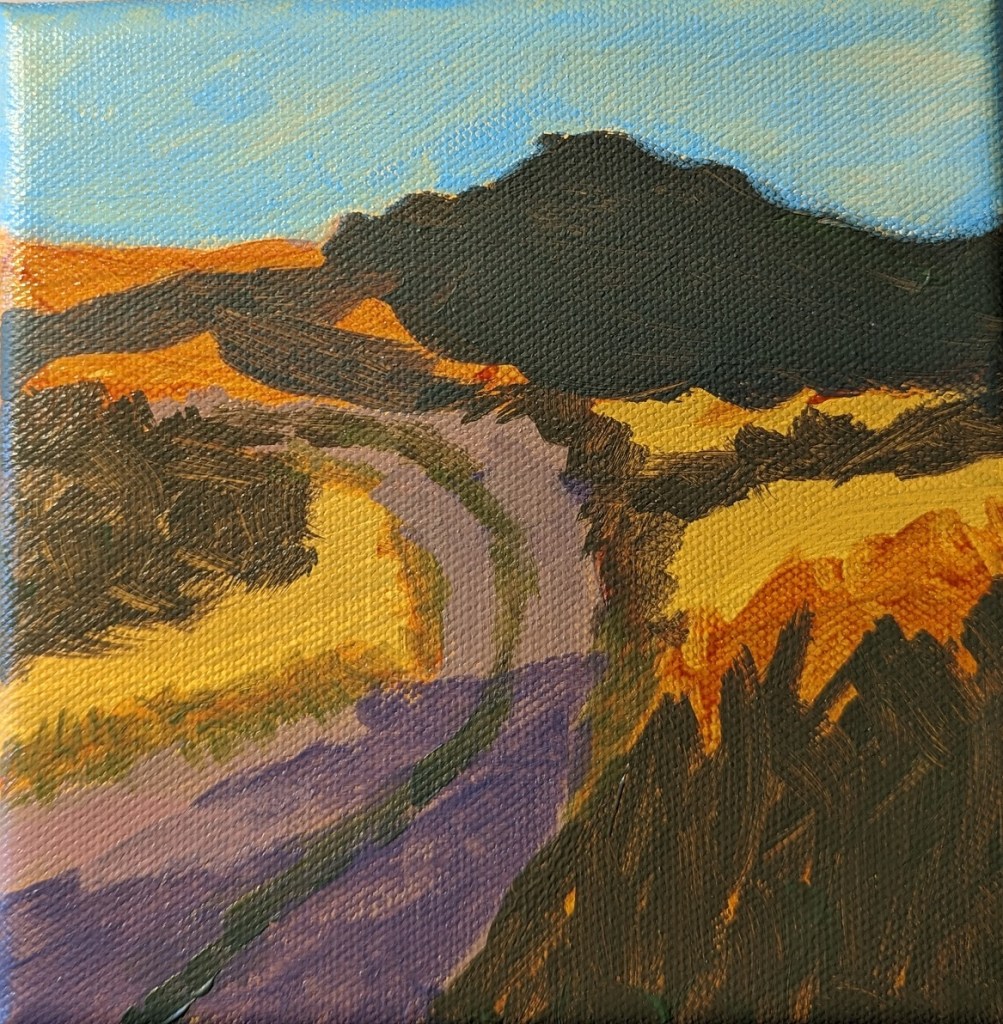
This 6×8 painting is from a tutorial by Paint Coach on Patreon. The idea is that you use a decently large brush (say, 1/2″) so that you are focused on the basic shapes as opposed to detail.
The 6×8 canvas size felt too small to me for all the different landscape “objects” — trees near and far, a stream, a path, mountains, etc. Whew!
Worse, my photo doesn’t adequately capture the colors I see in my own painting; the path is both grayer and more purple than what is shown, even though I fiddled with tint/saturation/brightness, etc. in the Photos app.
This 6″ x 8″ landscape — from PaintCoach Patreon — was a challenge, as far as getting the right colors. I got exasperated, and left the barn unpainted for several weeks, before finally just finishing it in a “I’m winging it” effort. (I figure, because it’s acrylic, that I can go back later and repaint the side of barn so that it’s not so gray as it appears.) But for now I am moving on.
I never did finish the foreground area; it should not be just a solid yellowish green. But, again, maybe later!
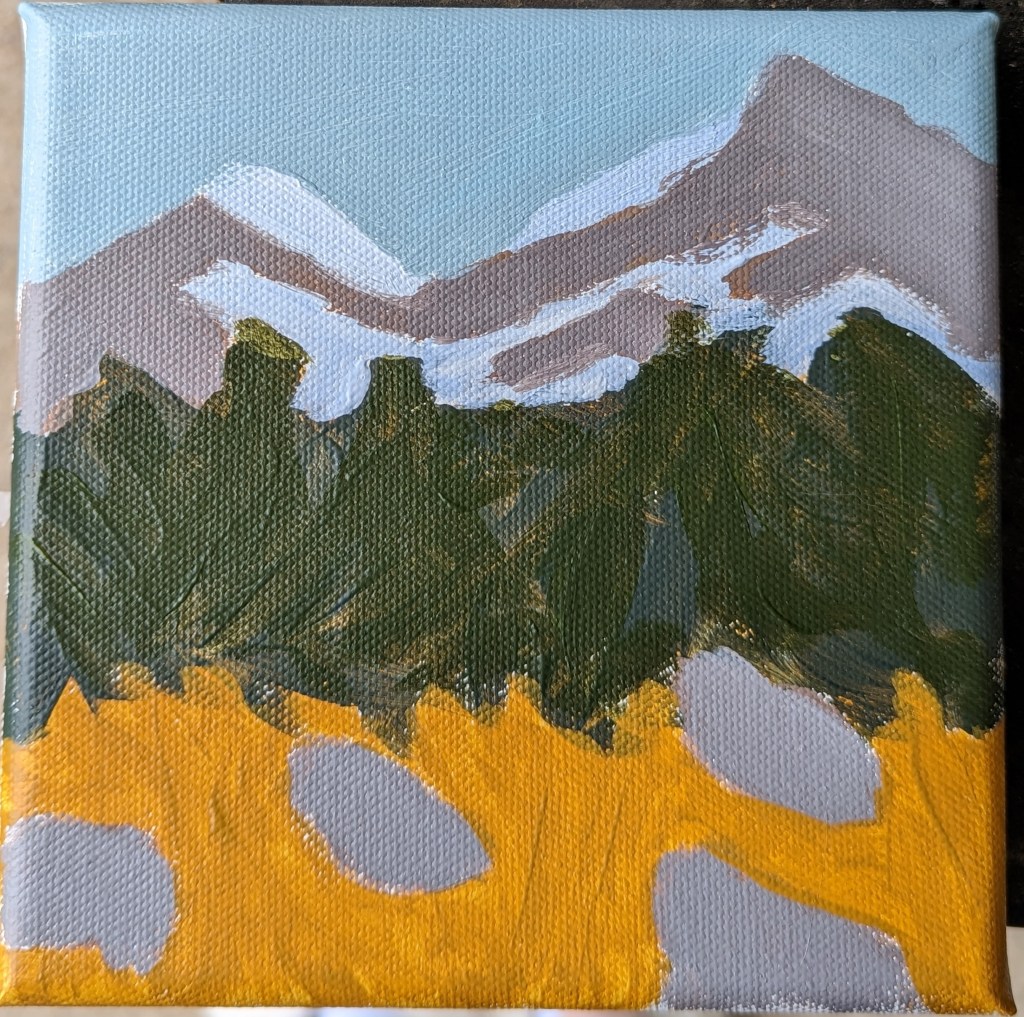
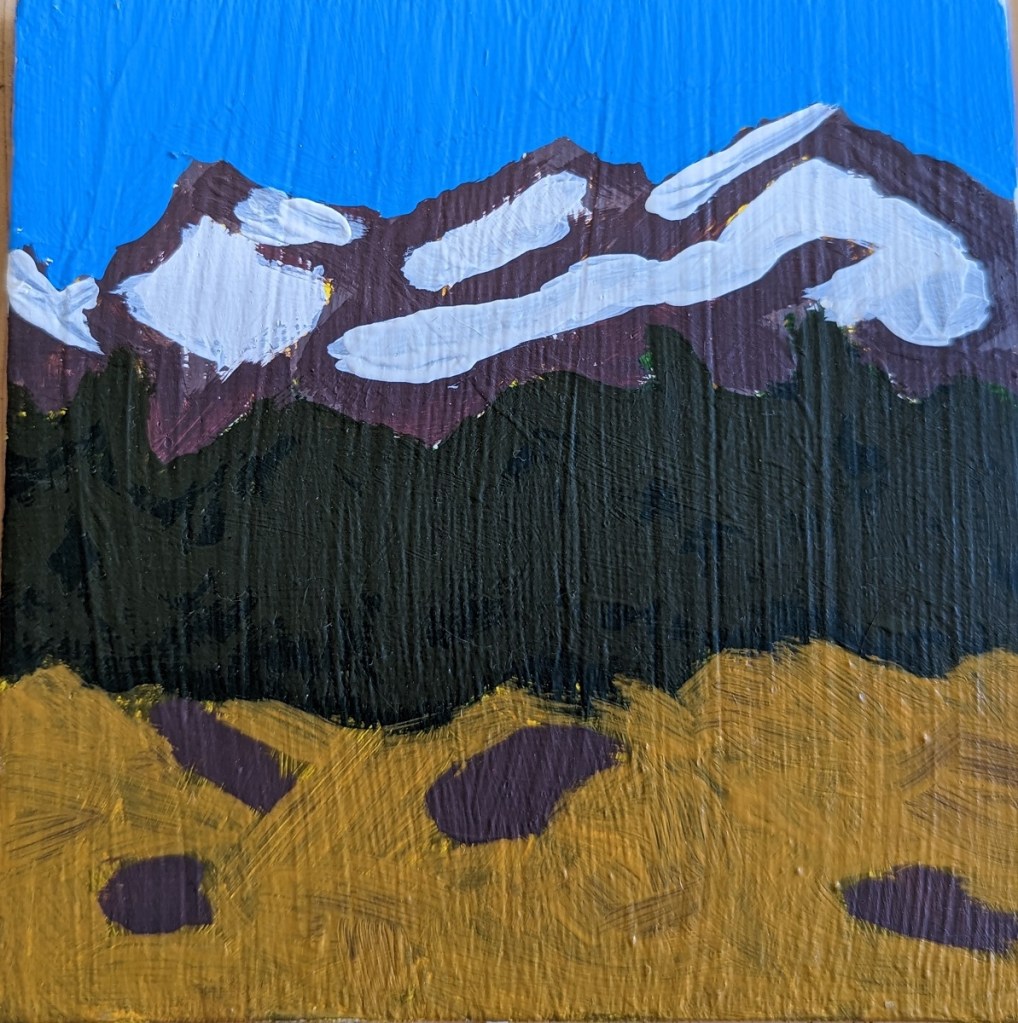
My original 5×5 painting of a mountain landscape, based on Mark Nelson’s “Learn to Paint in Acrylics with 50 Small Paintings: Pick up the skills * Put on the paint * Hang up your art” did not adequately reflect, in my opinion, atmospheric perspective. The mountain was unrealistically brown, the snow was unrealistically white, and the sky unrealistically blue!
So, I’ve tried again. The new version, obviously, is on the left. This was a 6×6 canvas, also painted in acrylics. It’s marginally better.
However, I think if I were to paint it yet a third time (!), I’d leave out the rocks in the foreground, instead adding a path through the meadow to the trees. I’d also work on my brushwork for both the mountain and the snowcap, and would add shadowed shapes to better indicate the form of the mountainside.
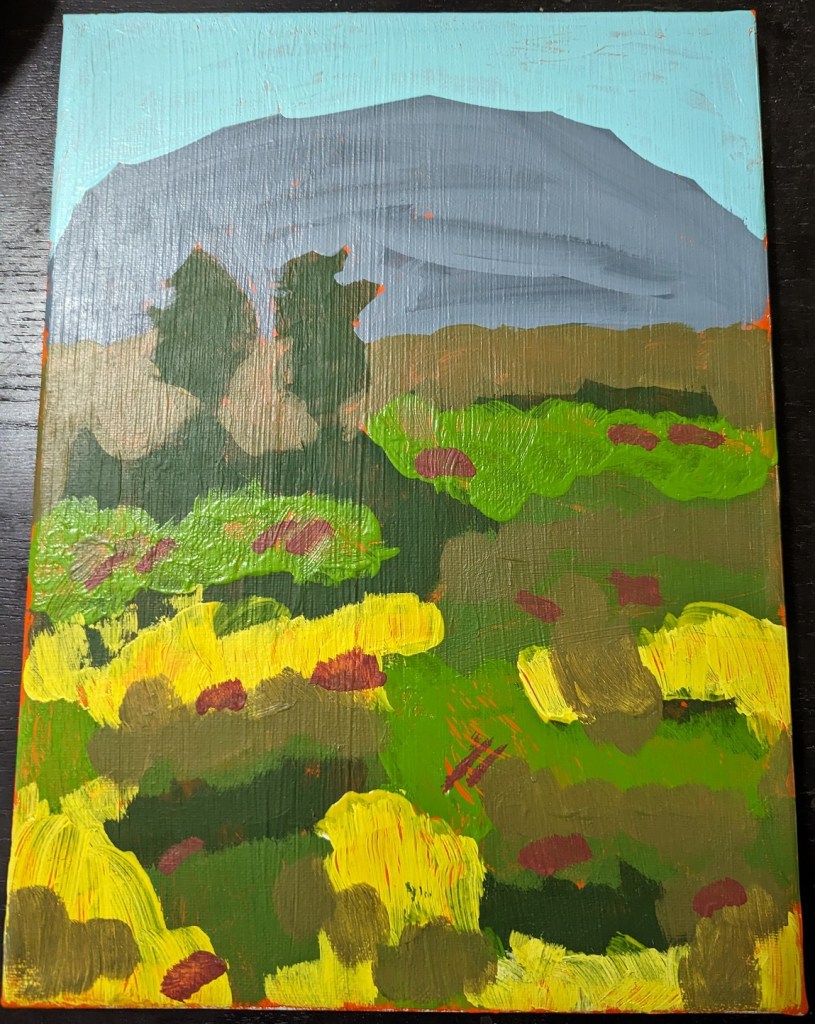
Using a demo project in Mixed Media Color Studio by Kellee Wynne Conrad, I attempted a landscape scene. And unfortunately I used a vivid fluorescent orange paint as background. This was a huge mistake!
The entire landscape became, for me, an exercise in trying to paint over the vivid orange, so I got very sloppy. I also discovered that my yellow paint was entirely too transparent — and that I need to pay attention to how transparent or opaque the paint I’m using is.
I also broke basic landscape rules around atmospheric perspective, in that the more distant the shapes (mountains, trees, etc.) are, the bluer they should be.
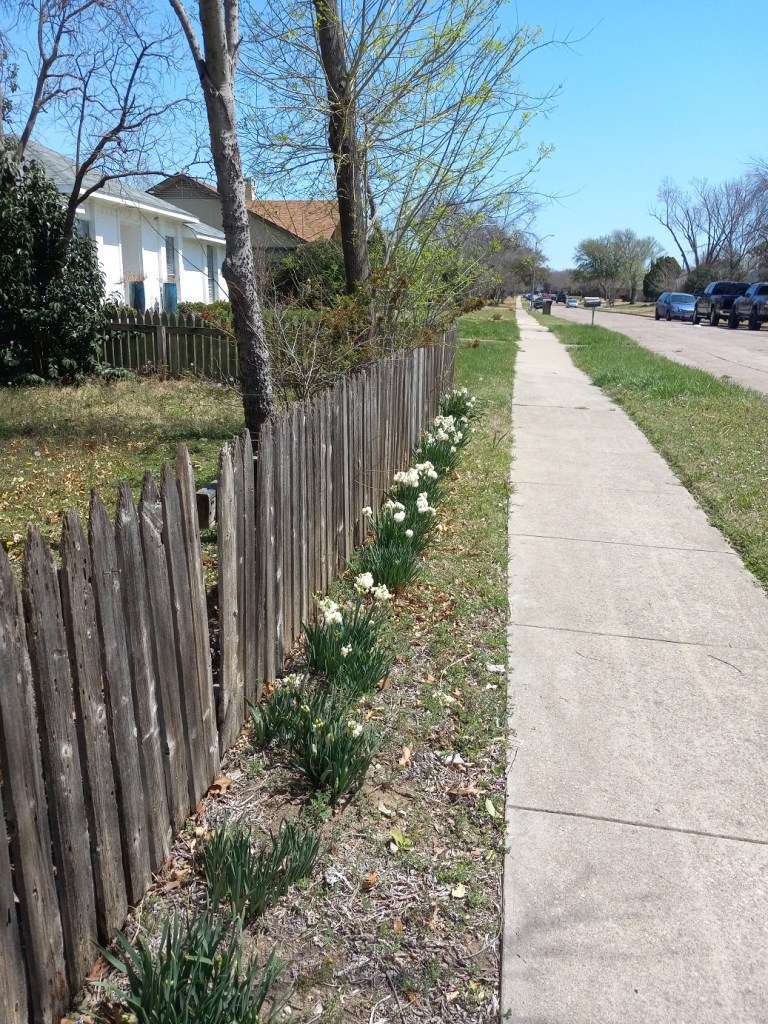
Today I’m posting Nature’s art.. Sunday was too gorgeous a day to stay inside. Lots of sun, nearly desert-dry, and quite warm (almost hot!) at 94 F (34 C). I look forward every spring to walking by this house about a mile from my own — because of the white narcissus in bloom alongside their fence.










 BetterLateThanNeverArt